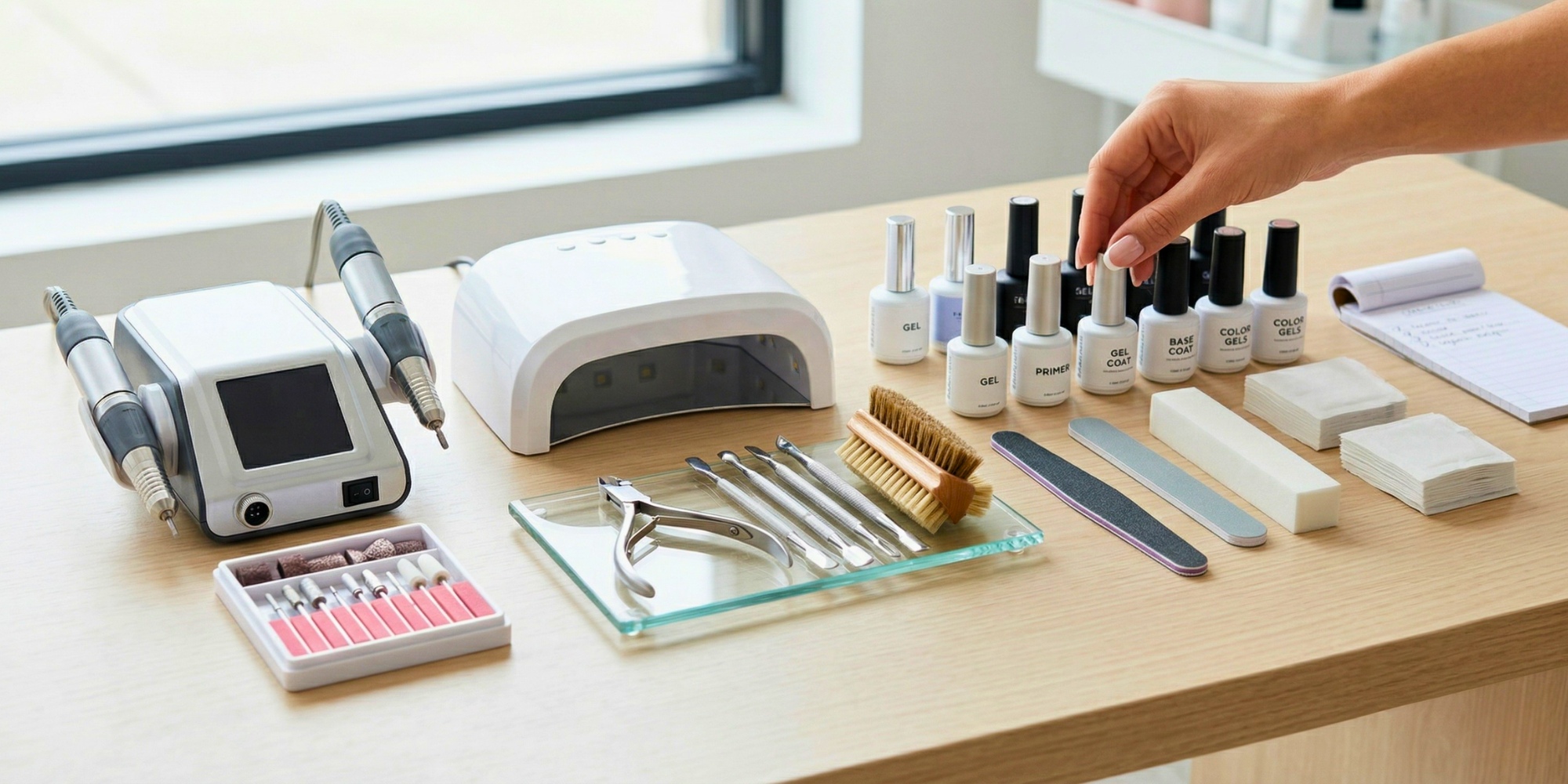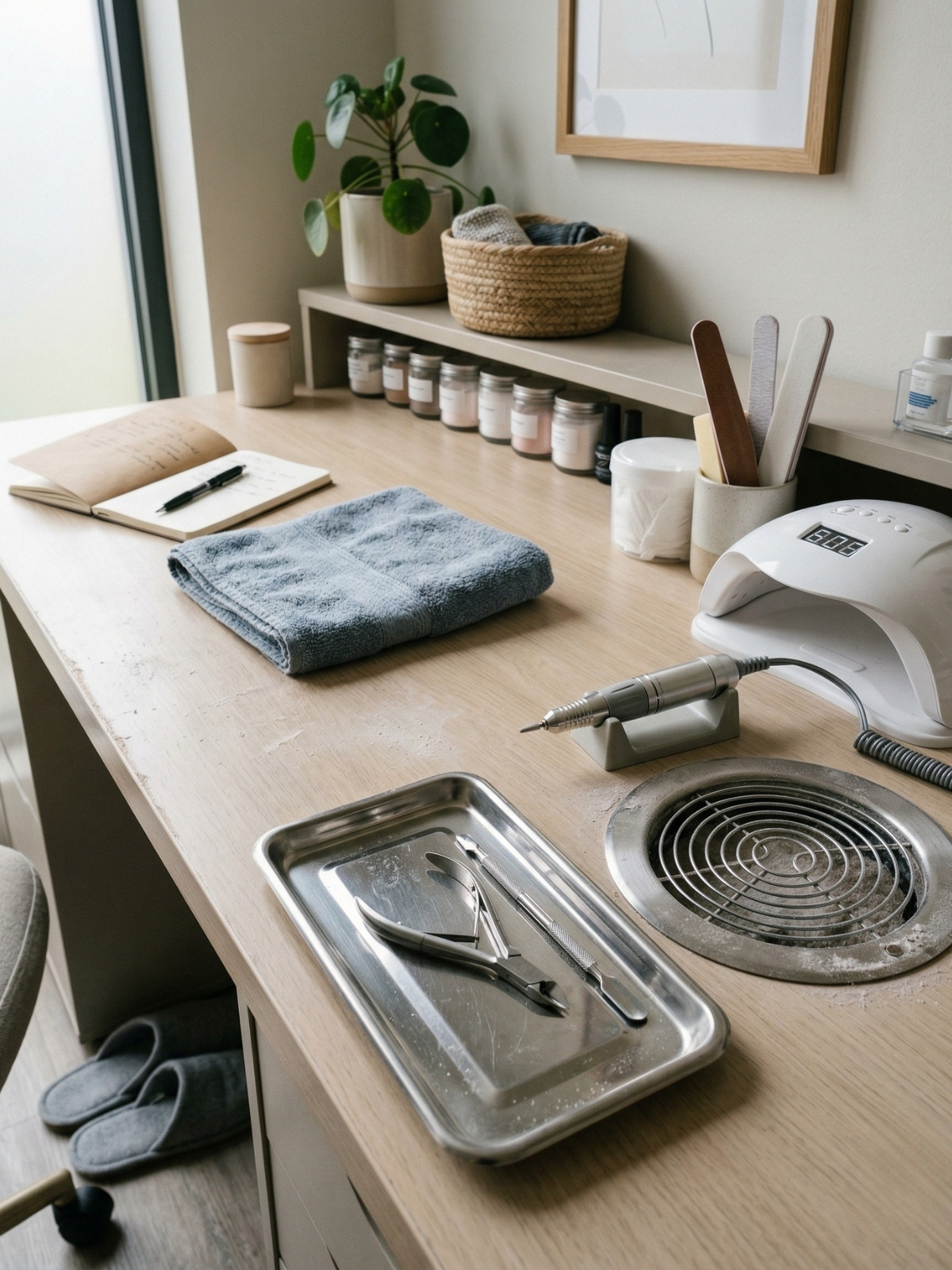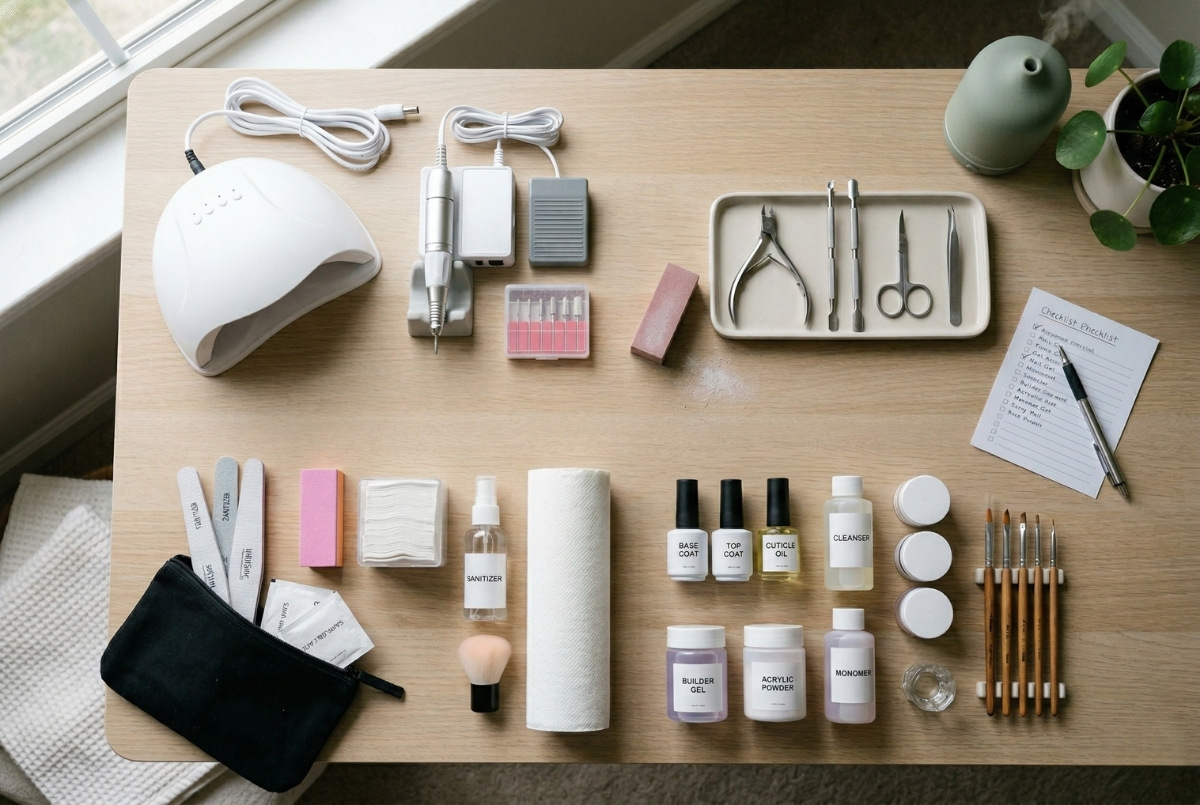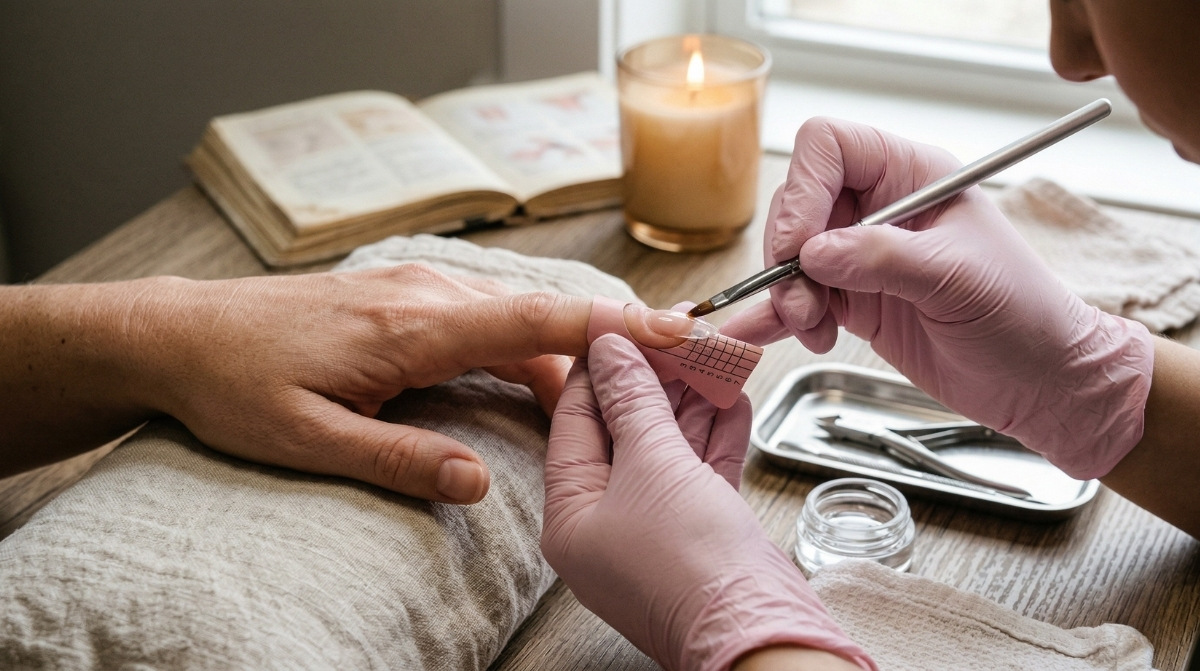

The Complete Nail Tech Workspace Guide: Tables, Tools, Safety & Booth Rental

Main Points to Remember

  • Protect Your Body: Repetitive hand work and prolonged awkward posture can place substantial physical strain on nail professionals. In a study involving 80 female nail technicians, 63.8% reported neck pain, highlighting the value of adjustable seating, comfortable client-hand positioning, supportive padding, and changing posture throughout the workday.
  • Control Airborne Exposure: A NIOSH-approved N95 respirator can filter certain airborne particles but does not provide protection from chemical gases or vapors. Effective ventilation remains essential, and Georgia’s adopted mechanical code requires source-capture exhaust of at least 50 CFM at each manicure and pedicure station.
  • Plan an Efficient Work Zone: Placing high-use equipment within a comfortable reach area and arranging it around your normal service sequence can reduce unnecessary reaching, awkward movement, cord interference, and disruptions during appointments.
  • Budget Beyond Weekly Rent: Booth rental rates can vary considerably, with published estimates commonly ranging from about $100 to $500 per week. Independent technicians must also account for supplies, insurance, payment processing, software, licensing, marketing, taxes, and other operating expenses.
  • Verify Your State’s Licensing Path: Required education differs across jurisdictions and licensing routes. Georgia’s complete nail care school curriculum totals 525 hours, while Arkansas rules prescribe a 600-hour manicure curriculum, so applicants should always confirm current requirements with the appropriate state licensing authority.

Moving from practicing nail services at home to working with paying clients requires more than artistic ability. A well-designed workspace can improve service flow, support safer working positions, and help you meet the rules that apply to professional salon environments. Whether you are preparing for licensure or reviewing our guide to nail technician certification and professional licensing, building an organized station is an important step toward a sustainable career.

Creating a Workstation That Supports You and Your Services

A nail station may look simple, but it becomes the center of nearly every service you perform. Because technicians often remain seated for extended appointments, furniture choices should support comfortable positioning, efficient movement, and everyday salon tasks rather than being based on appearance alone.

Nail technician choosing a clean manicure tool from an organized rolling storage unit filled with files, buffers, brushes, cuticle tools, and disposable supplies.

Adjust Your Workspace Instead of Forcing Your Posture

There is no single table height or seating arrangement that suits every technician. The OSHA guidance on nail salon positions and motions recommends using adjustable seating with back support, keeping the feet supported, raising or repositioning the client’s hand or foot to reduce forward bending, and providing enough lighting to complete detailed work without constantly leaning closer. Padding at points where the wrists or arms contact hard surfaces may also reduce unnecessary pressure.

Nail services involve repeated fine-motor movements that may continue for hours throughout the day. Frequent filing, prolonged leaning, and pressure against hard work surfaces can contribute to stress on muscles, joints, tendons, and nerves. A 2022 occupational ergonomics study of 80 female nail technicians reported neck pain in 63.8% of participants, making it the most commonly reported musculoskeletal complaint among the body areas assessed. The study does not show that every nail technician will develop serious pain, but it does demonstrate the importance of addressing awkward positions and repetitive physical demands.

Ergonomics should therefore involve more than purchasing an adjustable chair. OSHA also recommends repositioning clients when necessary, cushioning hard contact surfaces, taking brief breaks when practical, alternating positions, and stretching between tasks. Small adjustments made consistently can help reduce avoidable strain over the course of a busy schedule.

Select Furniture and Storage That Match Your Service Model

Storage plays an important role in maintaining proper sanitation. A nail workstation with drawers or other closed compartments can provide designated storage for implements after they have been properly cleaned and disinfected. Under the Georgia State Board of Cosmetology and Barbers sanitation rules, disinfected implements must be kept in a clean, closed, airtight drawer or container labeled for clean implements, while soiled implements must remain separately contained until they are processed. Single-use materials must also be handled and discarded appropriately. For technicians still assembling their first professional setup, our guide to essential nail technology procedures and professional tools provides additional equipment guidance.

The most suitable table also depends on where and how you plan to work. A permanent salon workstation may offer greater stability and integrated storage, while a folding portable table can be useful for mobile services, bridal appointments, house calls, or temporary event setups. In either case, the surface should provide enough room for the client’s hands and your active equipment without forcing you to overreach or work in a cramped position.

Managing Dust, Chemical Vapors, and Salon Air Quality

Artificial nail filing and the use of professional products such as adhesives, primers, removers, monomers, and polishes can introduce particles and chemical vapors into the work environment. Technicians may be exposed through inhalation as well as through skin or eye contact, making ventilation and responsible product handling essential parts of workstation planning.

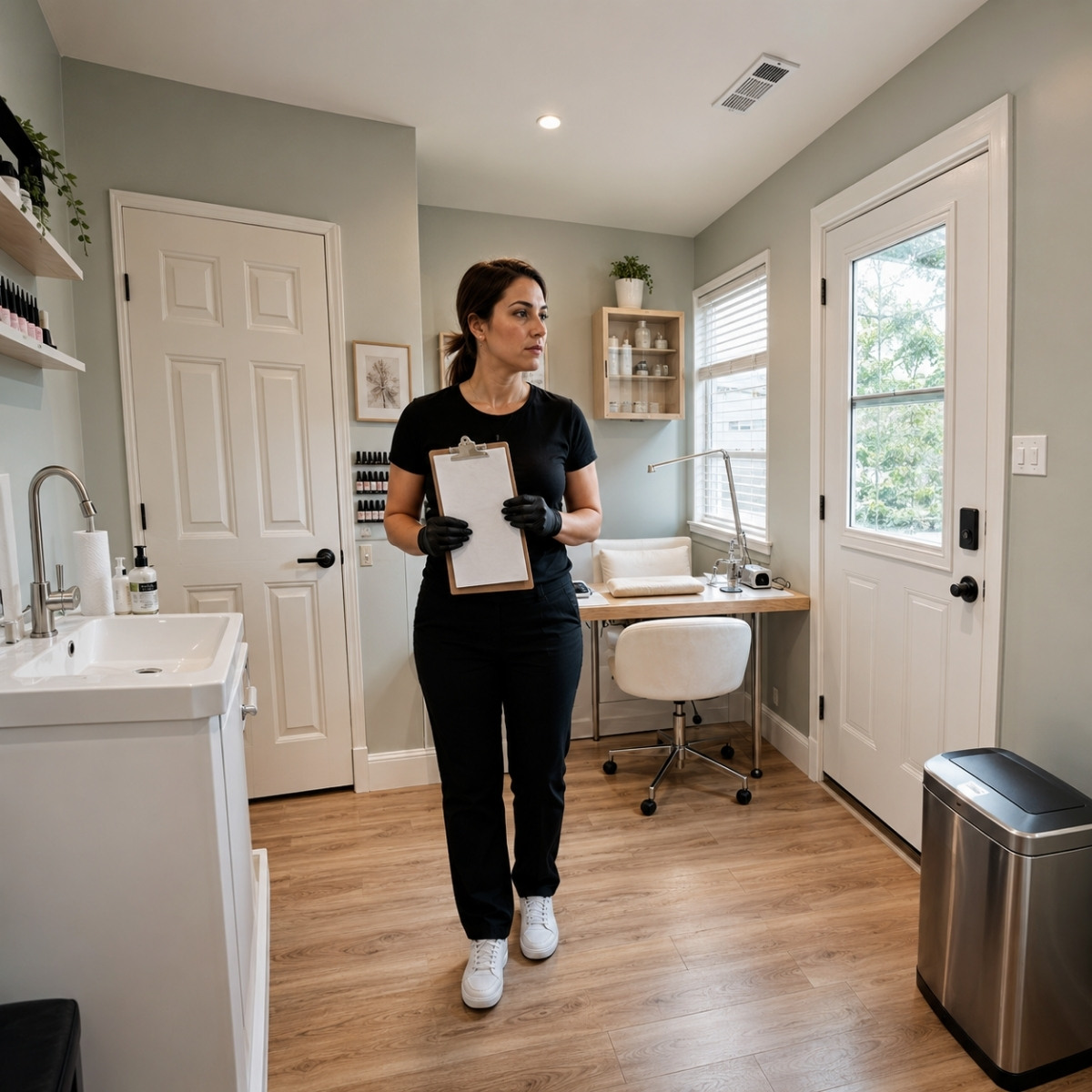
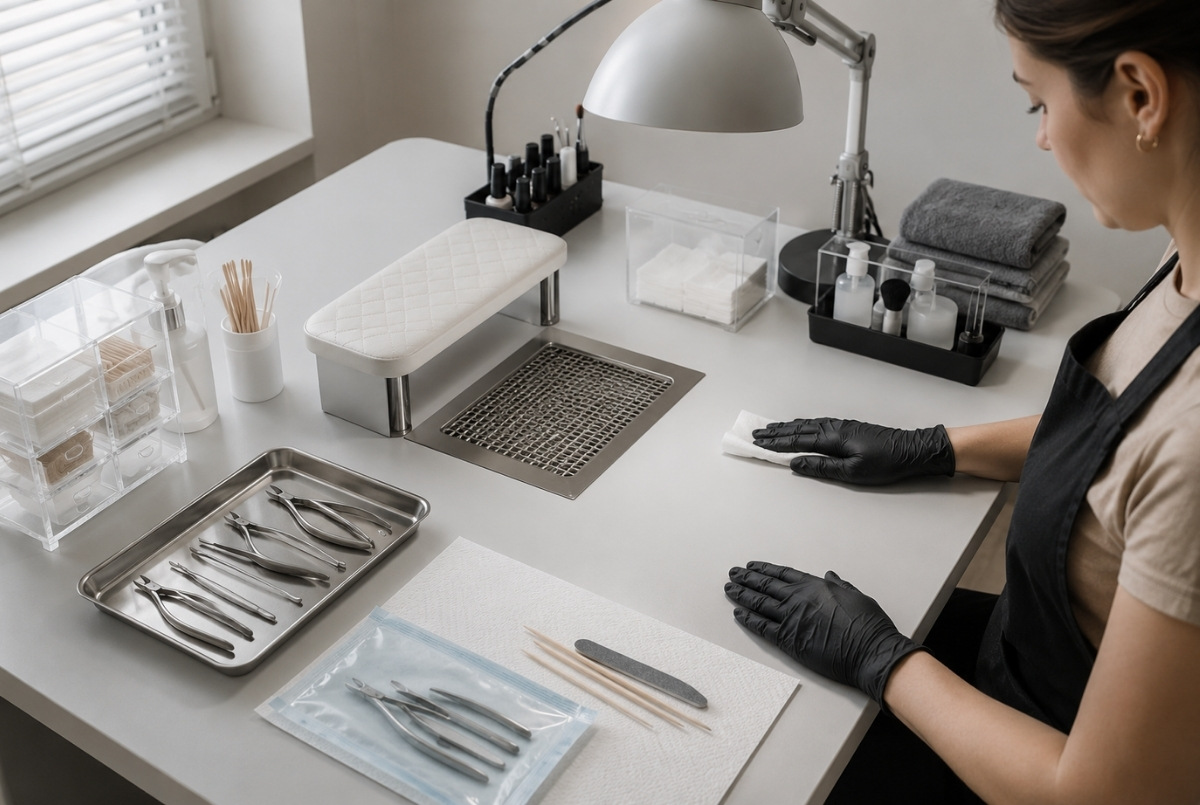
Prepared manicure station with sanitized reusable tools, separated disposable supplies, a clean work surface, task lighting, and a source capture ventilation grille.

Know What Your Ventilation Equipment Actually Does

A tabletop dust collector may reduce particles released during filing, but its effectiveness and function depend on how the unit is designed. Some systems capture particulate matter and return filtered air to the room, while others are designed as local exhaust controls that capture contaminants close to the source or discharge contaminated air outdoors. A portable unit should not automatically be assumed to provide the same exposure control as a professionally designed source-capture exhaust system.

According to CDC and NIOSH information for nail technicians, local exhaust ventilation may include downdraft ventilated tables and portable systems that filter contaminated air or exhaust it outside. Performance can vary according to airflow, equipment design, filtration, positioning, and maintenance. For that reason, technicians and salon owners should evaluate the specifications of the actual system rather than relying solely on labels such as “dust collector” or “extractor fan.”

Do Not Treat an N95 as Protection From Chemical Vapors

Different face coverings serve different purposes. Surgical and procedure masks are not respirators and should not be relied upon to control chemical vapor exposure. A properly fitted, NIOSH-approved N95 respirator can filter certain airborne particles, including dust produced during filing and buffing, but it does not protect the wearer from chemical gases or vapors.

The OSHA guidance on chemical hazards in nail salons identifies ventilation as an important method of reducing airborne chemical concentrations. If occupational conditions require respiratory protection for a particular chemical hazard, the appropriate respirator must be selected for that specific exposure and used in accordance with applicable OSHA respiratory protection requirements.

Air-quality controls should also be supported by careful product handling. Keeping containers closed when they are not in use, using suitable dispenser bottles, maintaining ventilation equipment, consulting Safety Data Sheets, and limiting unnecessary chemical evaporation can all help reduce exposure. These practices work together more effectively than relying on respiratory protection alone.

Understand the Source-Capture Rules That Apply to Georgia Salons

Ventilation requirements can also be established through state and local building codes. Under the 2024 International Mechanical Code with Georgia Amendments, manicure and pedicure stations must be provided with source-capture systems capable of exhausting at least 50 cubic feet per minute, or CFM, per station. Related Georgia mechanical exhaust requirements provide that when the workstation does not contain a factory-installed exhaust inlet, the inlet must be located within 12 inches horizontally and vertically of the point of chemical application. The exhaust system must operate continuously while the space is occupied.

General HVAC systems and small recirculating dust collectors should therefore not automatically be considered replacements for a source-capture system required by applicable code. Anyone planning a salon construction project, suite rental, or permanent workstation installation should verify the locally adopted mechanical code, amendments, permitting requirements, and inspection standards with the authority responsible for the property.

Organizing Your Station for Smoother Daily Services

A well-planned workstation can make repetitive services easier to perform consistently. Keeping equipment organized helps minimize unnecessary movement, prevents cords and tools from interfering with the active service area, and creates a cleaner environment for both the technician and the client.

Place Equipment According to the Order You Use It

Arrange frequently used tools around your normal service sequence rather than placing them wherever space happens to be available. For example, position your electric-file control unit so the handpiece cord can move freely from your dominant side without crossing the client’s arms or other equipment. Place your curing lamp where clients can comfortably move their hands in and out while leaving your primary work zone accessible.

There is no evidence that a single workstation arrangement will save the same number of minutes for every technician. However, keeping frequently used equipment within a comfortable reach range can reduce repeated repositioning, unnecessary stretching, and interruptions. The most effective setup is one that supports consistent movements while allowing you to maintain appropriate posture and sanitation practices.

Separate Clean Implements, Used Tools, and Disposable Supplies

An organized nail station must maintain clear separation between properly processed implements and items that have already been used. Under Georgia sanitation requirements, reusable nonporous implements such as nail clippers, cuticle nippers, metal drill bits, certain reusable nail forms, and appropriate metal or glass files must be properly cleaned and disinfected after use. Once processed, clean implements must be stored separately from soiled implements in designated closed storage.

Materials intended for a single service cannot simply be disinfected and used again. Georgia identifies items such as buffers, emery boards, electric-file sleeves and sanders, orange wood or birch wood sticks, porous foot files, and other materials that cannot be properly disinfected as single-use items that must be discarded after use. Autoclaves may be used as an acceptable processing method for compatible implements under Georgia rules, but nail tools are not universally required to be autoclaved or presented to clients in sealed sterilization pouches. Our guide to professional nail salon hygiene and aftercare practices explains additional sanitation considerations.

A practical station can include separate areas for clean implements, supplies currently being used, disposable products, chemicals, and contaminated implements awaiting processing. Used implements should be placed in the closed and covered container required by applicable sanitation rules rather than left exposed on the workstation. Chemical products should also remain properly closed and stored according to their labels and Safety Data Sheets instead of being placed together with clean implements.

A tidy and intentionally organized station can also reinforce a professional atmosphere. Visible attention to cleanliness and preparation helps clients understand that safety procedures are part of the service. Developing these habits during formal training can make setup, service, sanitation, and breakdown procedures easier to repeat consistently throughout a professional career.

What to Consider Before Renting Your Own Nail Workspace

Operating from your own booth or suite can provide greater independence, but it also introduces financial and legal responsibilities that may not apply in the same way to an employee position. The U.S. Bureau of Labor Statistics projects 7% employment growth for manicurists and pedicurists from 2024 through 2034. Technicians interested in independent work should consider the complete operating cost of a rental arrangement rather than focusing only on the advertised weekly rate.

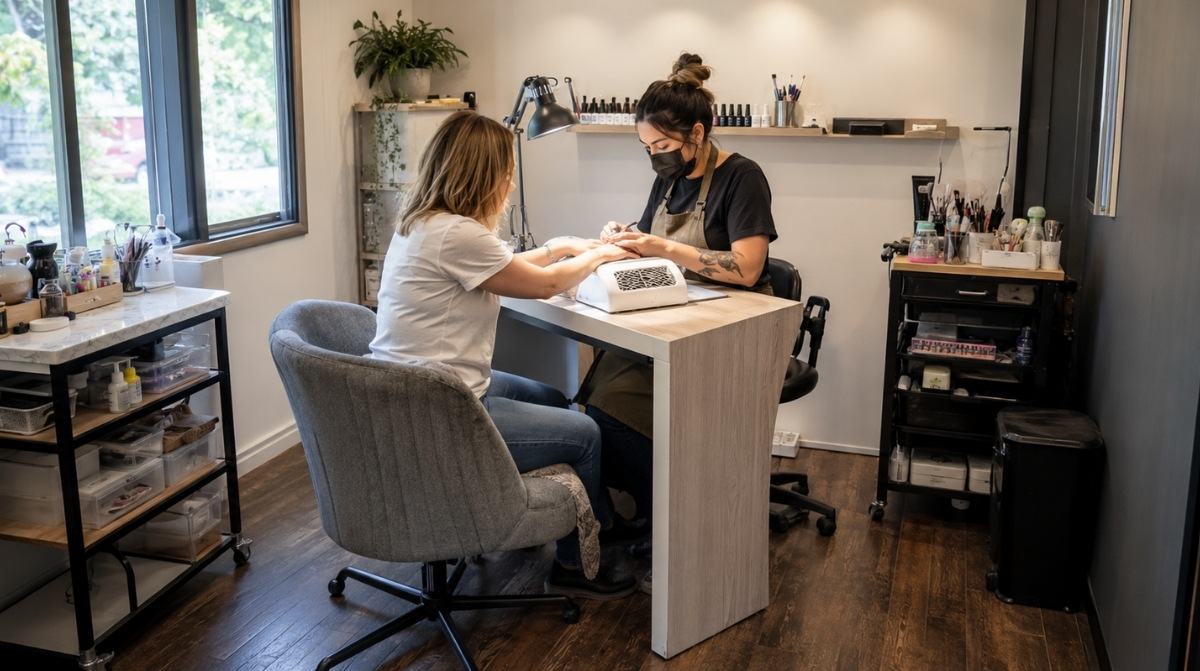
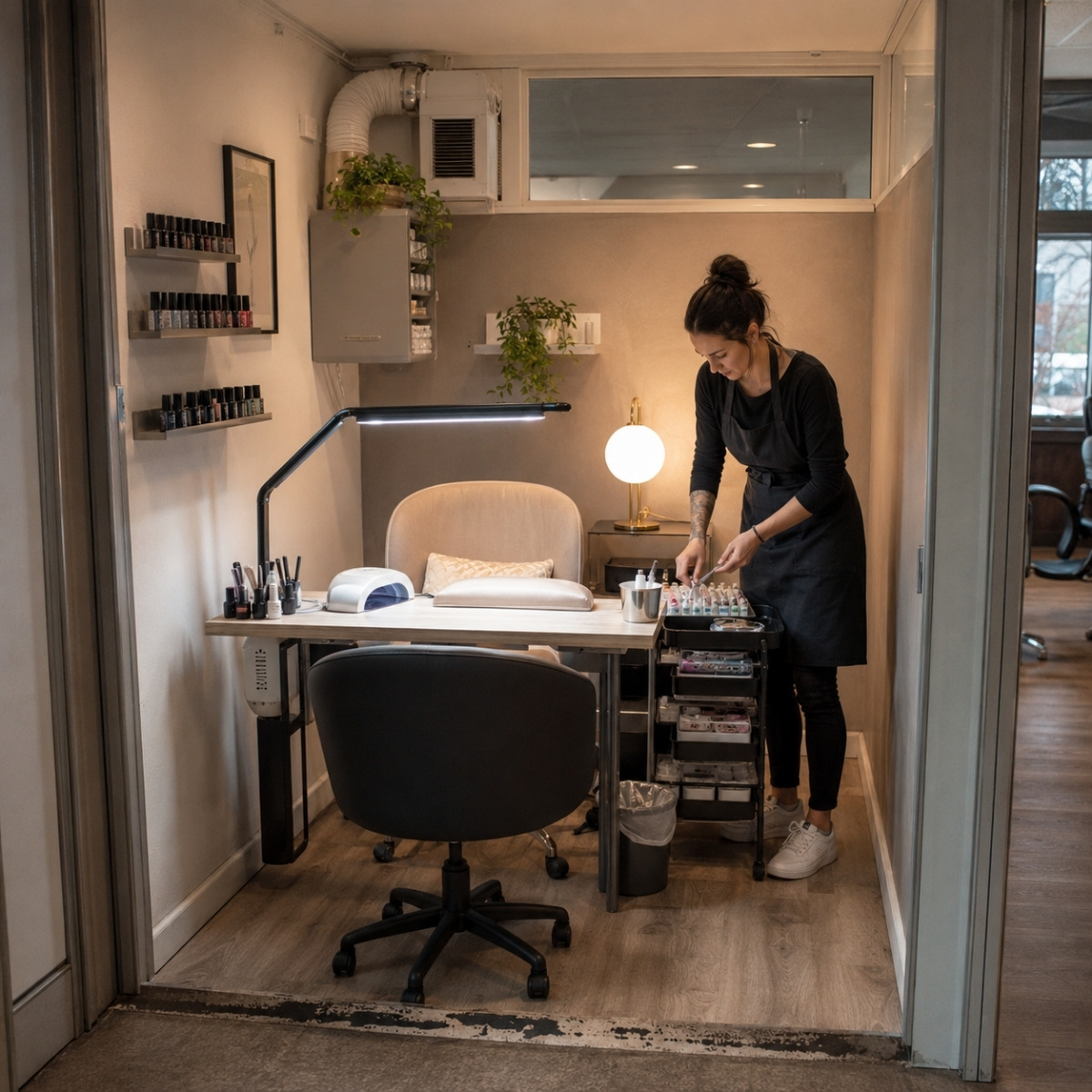
Nail technician arranging limited supplies in a compact rented booth with a manicure table, two chairs, rolling storage, task lighting, and ventilation equipment.

Inspect the Facility and Included Amenities Carefully

Before committing to a nail technician room or salon suite, review the physical infrastructure of the space. Confirm that electrical service can support your professional equipment, lighting is adequate for detailed work, and the facility provides access to any sinks, hot and cold running water, restrooms, sanitation areas, or other features required by applicable regulations. Ventilation should be evaluated before installing furniture because retrofitting compliant source-capture equipment after construction may be more complicated than incorporating it into the initial build-out.

Lease terms deserve the same level of attention. Determine whether rent includes electricity, water, guest Wi-Fi, laundry access, waste disposal, common-area cleaning, reception services, scheduling support, or other shared features. The agreement should also make clear whether maintenance, repairs, ventilation upgrades, and equipment improvements are the responsibility of the property owner or the individual renter.

Shared salon environments require additional planning. If several technicians use common sinks, sanitation areas, waiting spaces, or storage facilities, verify how those areas are managed and whether the arrangement supports the operational and regulatory needs of your services.

Work Out Your Full Monthly Operating Cost

Booth and suite rental prices differ substantially by city, neighborhood, facility type, and included amenities. The ZipRecruiter overview of nail technician booth rental describes a broad typical range of approximately $100 to $500 per week. This figure should be viewed as a general market estimate rather than a national average or guaranteed rate.

Rent is only one component of independent operating expenses. Recurring fixed costs may include business insurance, software subscriptions, registration fees, licenses, advertising, and suite charges. Variable expenses can rise with client volume and may include nail products, disposable materials, laundry, card-processing fees, and other service-related supplies.

A basic break-even calculation can help estimate the number of appointments required to cover operating costs. One approach is to divide recurring fixed expenses by the average contribution each service provides toward those expenses after service-specific variable costs are deducted. Because prices, service types, cancellations, discounts, processing fees, and other costs can fluctuate, the result should be treated as a planning estimate rather than an exact prediction of profitability.

Know the Responsibilities That Come With Independent Work

The BLS Occupational Outlook Handbook reports that 28% of manicurists and pedicurists were self-employed in 2024. Renting a booth, however, does not by itself establish a worker’s legal classification. According to the Internal Revenue Service, classification depends on the facts and circumstances of the working relationship, including behavioral control, financial control, and the nature of the relationship between the parties. Individuals who are properly classified as independent contractors are generally self-employed and may be responsible for self-employment taxes and estimated tax payments.

Licensing requirements are another important part of planning an independent career. Georgia’s official nail care school curriculum establishes a complete 525-hour nail care course. In Arkansas, the current Code of Arkansas Rules governing cosmetology schools prescribes a 600-hour manicure curriculum. Because education, examinations, reciprocity, and other licensing pathways vary by jurisdiction, prospective technicians should verify current requirements directly with the licensing agency responsible for the state where they plan to work.

A professional license may also be only one element of legally operating your own business. Depending on the location and arrangement, technicians may need to consider salon or establishment licensing, local business registration, tax requirements, zoning, insurance, building regulations, ventilation standards, and restrictions contained in the rental agreement.

Building Professional Habits Before Entering the Salon

Equipment selection, chemical safety, sanitation requirements, and business expenses can introduce challenges that are difficult to navigate without preparation. Formal beauty education can provide a structured environment for learning not only technical nail services but also the professional routines that support everyday salon work.

Training can introduce students to sanitation practices, safe product handling, salon procedures, ergonomics, and the technical skills required for their licensing pathway. Completing an approved program also allows students to earn the education hours required by their state while developing work habits that can support future employment or independent opportunities.

Prepare for the Next Stage of Your Nail Career

A successful professional foundation involves more than learning how to create polished nail designs. Understanding workstation organization, sanitation procedures, ergonomic habits, ventilation, and applicable regulations can help aspiring technicians enter the industry with stronger practical preparation.

To learn more about beginning your education with Career Academy of Hair Design, visit the Enrollment page. You can explore available program and campus information, request additional details, or use the school’s contact options to ask about visiting a campus and taking the next step toward enrollment.

Common Questions About Nail Workstations and Salon Rentals

How large should a nail table be in a compact studio?

There is no universal table dimension required for every nail workspace. Many compact commercial models are approximately 36 to 42 inches wide and 16 to 20 inches deep, but the appropriate size depends on your available floor area, ventilation configuration, equipment, and working posture. The surface should provide sufficient room for a curing lamp, electric file, and client hand support without forcing the technician to lean forward excessively.

When should the filter in a nail table ventilation system be changed?

Always follow the maintenance instructions provided by the equipment manufacturer because filtration systems vary. For applicable ventilated tables equipped with charcoal filters, OSHA nail salon chemical hazard guidance recommends replacing charcoal filters at least once per month and cleaning the catch basin at least weekly. Workstations with heavier filing volume may require more frequent maintenance. Replacing filters in a recirculating unit does not automatically make that equipment equivalent to a source-capture exhaust system required under applicable mechanical codes.

Should a recent graduate choose commission work or booth rental?

The better arrangement depends on the technician’s finances, client base, experience, and career goals. Commission employment may reduce certain startup expenses and, depending on the salon, may include access to established clientele, equipment, supplies, or additional training. Booth rental can provide more operational independence but generally places more responsibility on the technician for rent, products, insurance, taxes, marketing, and attracting clients. Reviewing anticipated revenue and operating expenses before signing a rental agreement can help determine which arrangement is more practical.

Which types of insurance should an independent nail technician consider?

Independent nail professionals commonly consider professional liability coverage for claims associated with their services and general liability coverage for broader risks such as certain injuries or accidental property damage occurring in the business environment. Appropriate coverage varies according to the technician’s services, business structure, state and local requirements, property owner, and rental agreement. Any insurance obligations included in a booth or suite lease should also be reviewed before beginning operations.

Becoming a Medical Nail Technician: Training Requirements and Career Opportunities

A packed appointment book is not the only direction a nail career can take. Some professionals eventually begin looking for work that places greater emphasis on careful consultations, sanitation, client screening, and deliberate service rather than speed alone.

That interest is especially relevant as more clients manage conditions that can affect their feet. The Centers for Disease Control and Prevention estimates that 40.1 million people in the United States had diagnosed or undiagnosed diabetes in 2023. Diabetes and certain vascular, neurological, immune, or mobility conditions can increase concerns involving reduced sensation, slow healing, fragile skin, circulation, and infection.

These needs have encouraged some licensed nail professionals to pursue additional safety education. Understanding how to become a medical nail technician can help you decide whether this privately certified specialty fits your career goals, while also clarifying what the credential does and does not legally permit.

What Matters Most Before You Specialize

  • It Builds on an Existing Beauty License: A Medical Nail Technician, often shortened to MNT, is generally a licensed nail technician or cosmetologist who completes additional private education related to higher-risk clients, infection prevention, screening, and referral.
  • It Does Not Create Medical Authority: An MNT certificate does not turn a beauty professional into a nurse, physician, or podiatrist. It does not authorize diagnosis, wound care, prescribing, or treatment of disease.
  • The Credential Is Privately Issued: There is no single government-issued MNT license used throughout the United States. Course titles, prerequisites, assessments, and internship expectations depend on the certificate provider.
  • Your State License Remains the Legal Limit: Services must stay within the scope of the nail or cosmetology license issued by the state where the appointment takes place.
  • Income Is Not Standardized: Federal wage databases do not track Medical Nail Technicians as a separate occupation, so specialization should not be treated as a guaranteed path to a particular salary.

Where an MNT Fits Between Beauty Services and Health Awareness

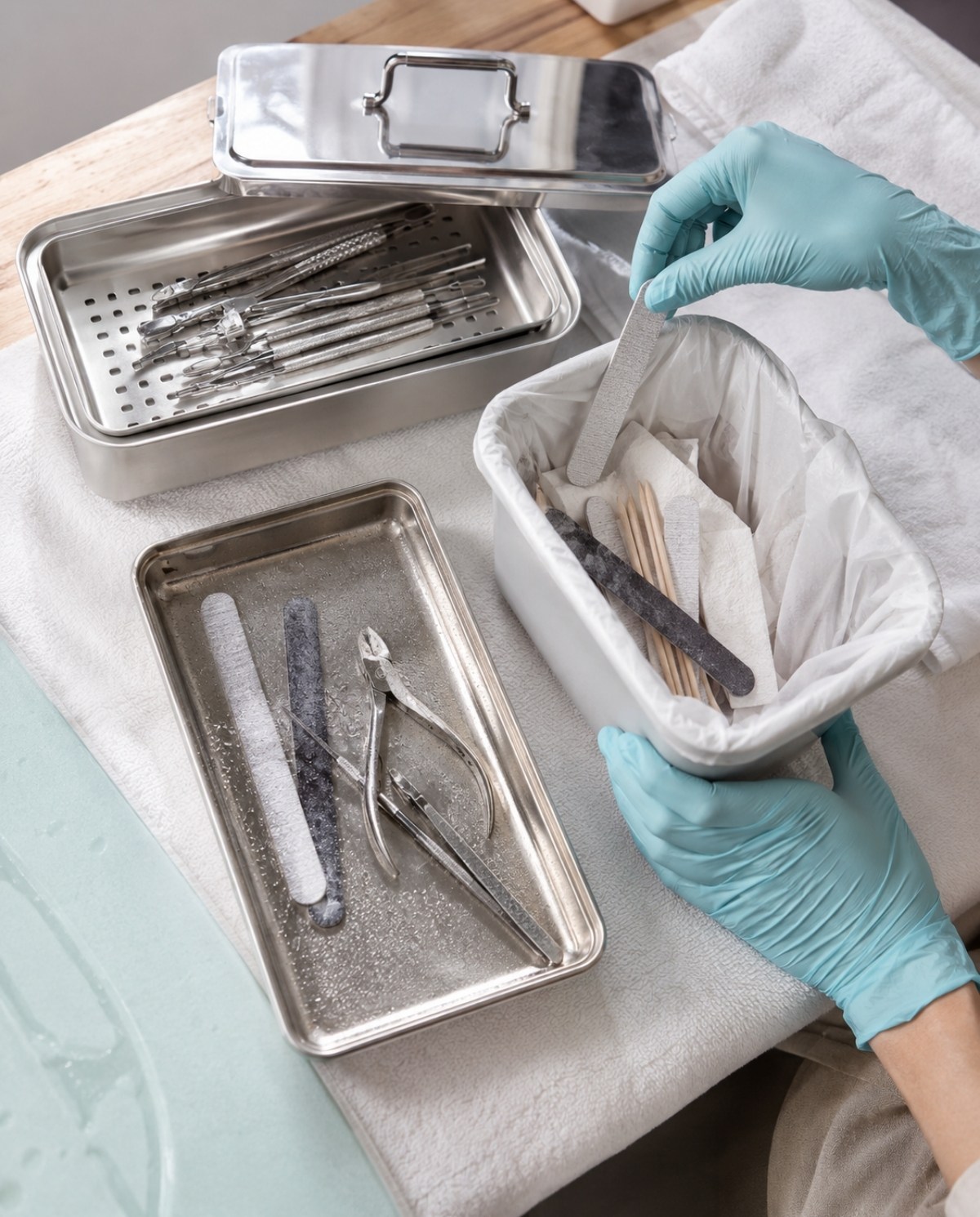
Gloved hands separate used nail implements from disinfected tools while disposable files are discarded at a clean professional workstation.

A Medical Nail Technician remains a beauty professional, but the way that person approaches an appointment may be more cautious than a conventional walk-in service. The process may include a detailed consultation, visual screening, sanitation documentation, conservative product choices, and a clear plan for referring concerns that do not belong in a salon setting.

The title is frequently used for licensed professionals who have pursued private education concerning older adults, people with diabetes, and clients whose health history may make routine services more complicated. The word medical describes the health-aware nature of the education. It does not mean the technician holds a healthcare license.

Common principles within this specialty include:

  • Preventing Contamination: The CDC defines asepsis as preventing contact with microorganisms. In a nail setting, that may involve proper hand hygiene, preparing the workstation, using disposable supplies when appropriate, and cleaning and disinfecting reusable implements according to state rules and product labels. Asepsis is not identical to sterilization, which is intended to destroy all forms of microbial life.
  • Considering Waterless Methods: Dry or waterless pedicures can reduce exposure associated with shared footbaths, but they do not eliminate every possible route of cross-contamination. Hands, surfaces, products, and reusable tools still require proper infection-control practices. Balance Health describes waterless care as a feature of many medical-pedicure services. The National Institute of Diabetes and Digestive and Kidney Diseases also advises people with diabetes not to soak their feet because soaking can make the skin too dry.
  • Keeping Services Cosmetic: An MNT may provide nail and skin maintenance that falls within the professional’s state-authorized scope. Painful, infected, bleeding, deeply ingrown, or significantly abnormal nails may need evaluation by a podiatrist or another qualified healthcare provider before any cosmetic service is considered.
  • Knowing When Not to Proceed: Screening is not diagnosis. A technician may notice redness, drainage, swelling, warmth, open skin, or a sudden nail change and decide that an appointment should be modified, delayed, or declined. The technician can describe what is visible without naming the medical condition causing it.
  • Selecting Products Conservatively: Product safety depends on the client and the condition of the skin. NIDDK specifically warns people with diabetes not to use liquid corn and callus removers because these products can damage the skin and cause infection. This guidance does not mean every exfoliating product is forbidden for every client, but it shows why stronger products require careful judgment.

The most important skill in this role is not treating a medical problem. It is recognizing when a cosmetic service may create unnecessary risk. An MNT does not remove infected tissue, provide wound care, prescribe an antifungal treatment, or attempt to correct a condition that belongs within podiatry or medicine.

Maintaining strong everyday sanitation remains essential whether you work with higher-risk clients or a general salon population. Our guide to nail salon hygiene and professional aftercare explains practical habits that help reduce cross-contamination and protect both clients and technicians.

Foot-care needs also extend far beyond the nail industry. Mordor Intelligence estimates the global podiatry services market at $4.87 billion in 2026 and reports that routine foot care represented 46.87% of that market in 2025. These are podiatry market-share figures, not MNT employment statistics. They show the significance of routine foot maintenance within the wider foot-health field but do not prove that every MNT will receive medical referrals or achieve a certain income.

Some healthcare practices may hire, work with, or refer suitable clients to safety-trained nail professionals. Such relationships depend on state law, office policies, professional experience, insurance arrangements, and the exact cosmetic services being offered. A certificate can support a professional introduction, but it cannot promise a job or referral stream.

Building the Credentials in the Right Order

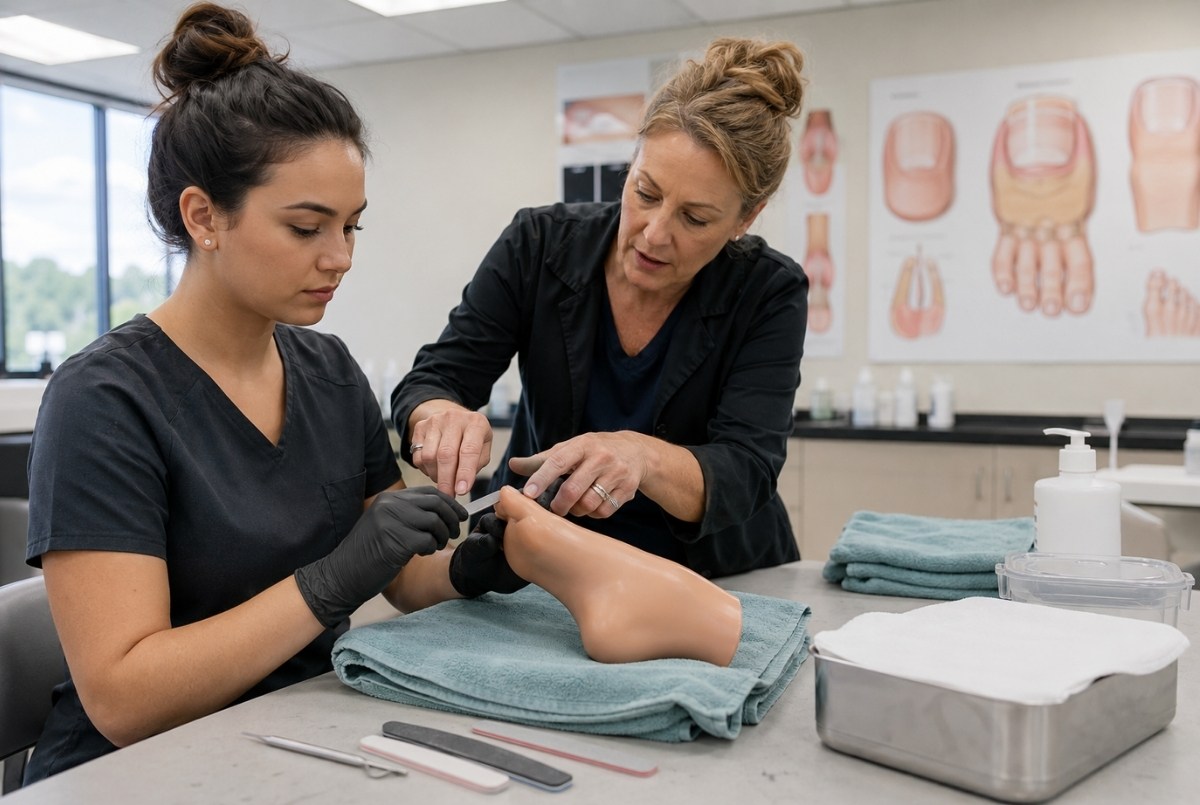
Manicuring student practices conservative foot care on a training model while an instructor demonstrates safe hand positioning at a sanitary classroom workstation.

Before pursuing advanced education, you need the legal foundation required to work as a nail professional. That ordinarily means completing an approved nail or cosmetology program, satisfying the licensing agency’s requirements, and obtaining the license required where you plan to provide services.

For a closer look at the difference between school completion and professional licensing, read our guide explaining whether a nail technician needs a certificate and how the licensure process works.

Arkansas publications currently contain figures that applicants should review carefully. The 2025 Arkansas cosmetology law compilation lists at least 480 hours of manicurist training as a prerequisite for examination eligibility. Meanwhile, Career Academy of Hair Design currently publishes its own Manicuring program as a 600-hour course that may be completed in approximately five months.

Because statutory language, administrative rules, school catalogs, and implementation dates are not always updated at the same time, applicants should confirm the operative licensing checklist directly with the Arkansas Department of Health before relying on a particular hour figure.

A foundational license alone does not make someone an MNT. The advanced title comes from a separate private provider, and the structure is not identical across the industry.

One established example is the pathway offered by Nailcare Academy. Within its system, the complete MNT sequence includes:

  • Advanced Nail Technician, or ANT, certification
  • Wellness Nail Technician, or WNT, certification
  • The MNT internship preparation program
  • A documented 40-hour proctored internship in a medical setting

Nailcare Academy states that its advanced programs in the United States are intended for licensed nail technicians and cosmetologists. Its MNT internship preparation program requires both ANT and WNT certification as prerequisites.

Another private provider may use a different title or sequence. Before enrolling, review the subjects covered, instructor experience, assessments, practical expectations, refund policies, internship arrangements, graduate support, and admission requirements. You should also compare the techniques taught with the services your state license actually permits.

Which Parts Can Be Studied Remotely?

Online education can make advanced theory more accessible to working professionals. Topics such as anatomy, infection prevention, chronic-condition awareness, consultation methods, documentation, and referral communication may be taught remotely.

Nailcare Academy states that its classes are online. However, its MNT certification process also includes a separate 40-hour proctored internship in a medical setting. The internship is guided by a procedure log that must be verified by the proctor before the MNT certificate is issued.

The internship should not be described as purely observational. According to the provider, it can introduce technicians to medical-office expectations while allowing them to perform or document cosmetic activities that remain within their existing state license and the supervising site’s policies. It never gives the student permission to diagnose vascular disease, neuropathy, fungal infection, or any other medical condition.

When comparing online programs, ask:

  • Which lessons are completed online?
  • How is knowledge or practical competency assessed?
  • Is an internship required?
  • Who is permitted to supervise the internship?
  • Does the provider help students locate an appropriate site?
  • Must applicants already hold an active nail or cosmetology license?
  • What happens if the student’s state does not allow a technique taught in the course?

Your Certificate Never Replaces Your State Scope

Advanced knowledge can improve decision-making, but it does not rewrite licensing law. A private MNT certificate cannot add procedures to an Arkansas manicurist license or permit the holder to practice podiatry.

The Arkansas Cosmetology Act defines the work authorized under a manicurist license, including cosmetic services such as cutting, trimming, cleansing, filing, polishing, protecting, extending, or beautifying nails, along with specified cosmetic care of the hands, arms, feet, and ankles. The license does not authorize medical diagnosis or treatment.

An explanation from Nailcare Academy also states that ANT, WNT, and MNT certificates do not enlarge the technician’s original state scope of practice. Working in a physician’s office does not independently grant a technician the authority held by the physician.

Visible concerns that may justify delaying a cosmetic service and recommending medical evaluation include:

  • Open cuts, sores, ulcers, or active bleeding
  • Blisters, drainage, or signs suggesting infection
  • Unusual redness, warmth, swelling, or inflammation
  • Severe pain or a sudden change in a nail or foot
  • An ingrown nail that has entered or broken the skin
  • Thick, yellowed, curved, or significantly distorted nails in a person with diabetes or reduced sensation
  • A client who cannot adequately see, feel, or reach their feet

NIDDK advises people with diabetes to have a foot doctor trim their toenails when they cannot see, feel, or reach their feet, when their nails are thick or yellowed, or when the nails curve and grow into the skin. That guidance supports referral to an appropriate medical professional rather than aggressive cosmetic intervention.

Certification also does not remove professional liability. Technicians must follow applicable licensing and sanitation rules, employer policies, product directions, and the boundaries of their training.

Professional liability insurance and detailed client forms may be required by an employer, landlord, referral partner, insurer, or certificate provider. They should not automatically be described as universal Arkansas licensing requirements unless a current law or rule specifically requires them. Even when not mandated, suitable insurance and consistent documentation may still be valuable business safeguards.

Income Potential Without the Hype

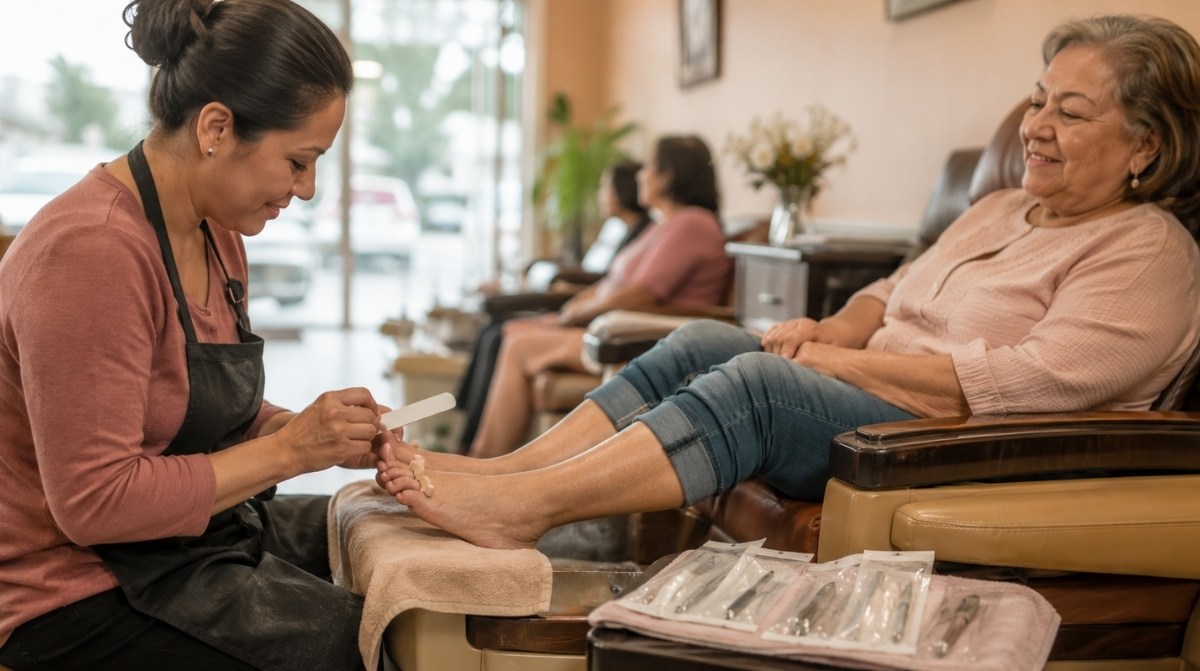
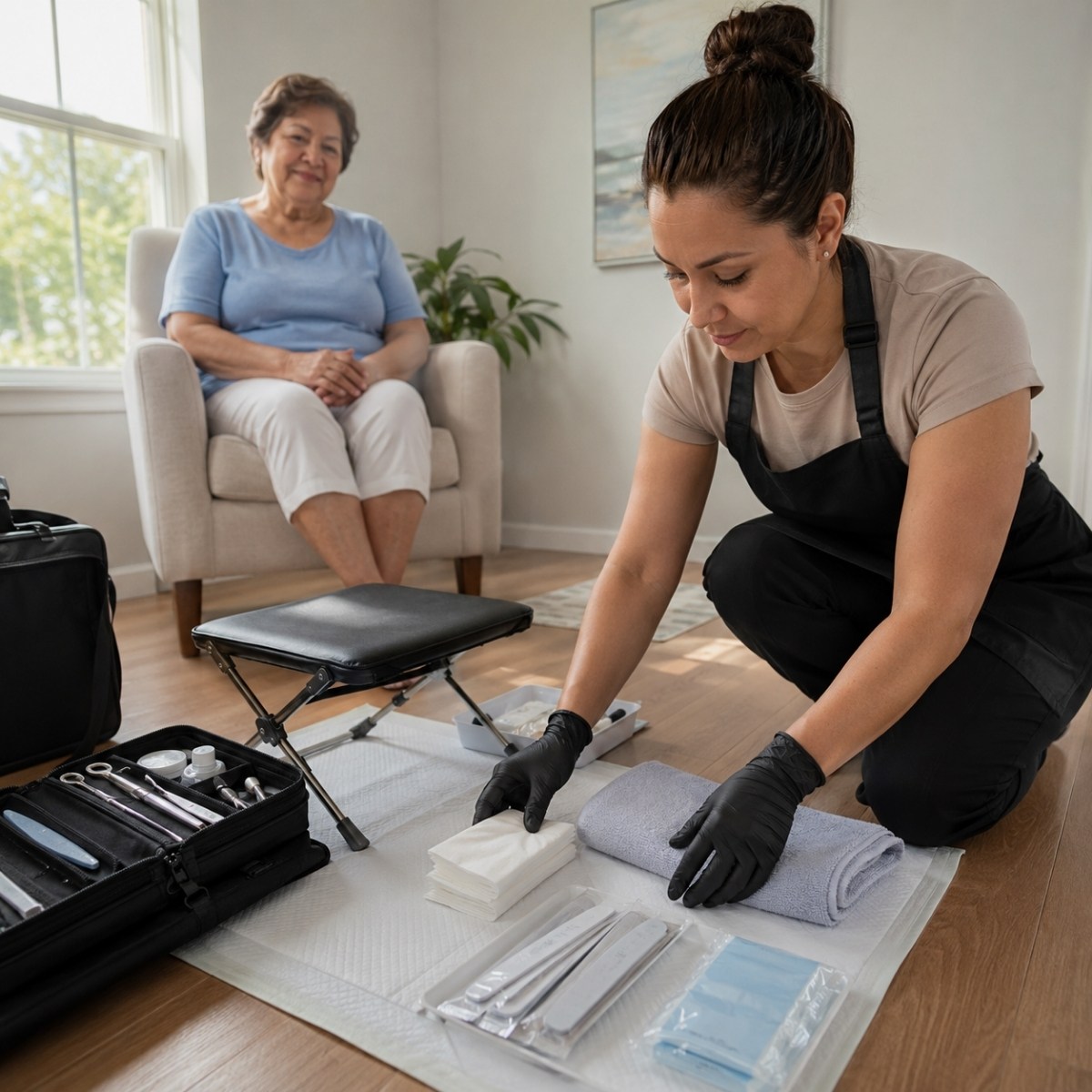
Mobile nail professional arranges sealed supplies, fresh towels, gloves, and disinfected cosmetic tools before serving an older client in a private room.

A focused specialty may help a technician distinguish their services through longer consultations, careful sanitation, structured screening, and a quieter appointment experience. It may also appeal to clients who value extra time and attention. However, none of those benefits creates a guaranteed premium price or stable income.

Medical Nail Technicians are not tracked as a separate occupation in federal employment databases. The latest national Occupational Employment and Wage Statistics release lists a median hourly wage of approximately $17.19 for manicurists and pedicurists in May 2025. The U.S. Bureau of Labor Statistics Occupational Outlook Handbook projects 7% employment growth for the broader occupation from 2024 through 2034, with about 24,800 openings per year on average.

These figures do not tell you what an independent MNT business will earn. BLS occupational wage estimates also exclude self-employed workers, which matters because many nail professionals operate independently.

Actual results may be influenced by:

  • Local demand for specialized services
  • State licensing restrictions
  • Employment, booth-rental, suite, or business-owner status
  • Appointment duration and pricing
  • Client retention and referral activity
  • Rent, supplies, equipment, insurance, taxes, and payment fees
  • Unpaid scheduling, cleaning, bookkeeping, and marketing time
  • The technician’s experience and weekly booking capacity

A specialist may choose fewer appointments with additional consultation and documentation time. Whether that model supports higher prices depends on the market and the value clients perceive. It is not accurate to assume that clients will automatically pay substantially more simply because a technician earns an advanced certificate.

Gross service sales also should not be confused with personal income. Rent, products, continuing education, insurance, licensing, taxes, cancellations, and administrative work can significantly reduce the amount the owner keeps.

The realistic advantage of specialization is the ability to develop a clearly defined service model. The financial outcome still depends on pricing, demand, expenses, compliance, reputation, and business management.

Begin with a Strong Manicuring Foundation

Advanced safety education is most useful after you have developed dependable foundational skills. Nail anatomy, sanitation, product knowledge, consultation, client communication, and practical technique all contribute to the judgment required in a specialized setting.

At Career Academy of Hair Design, the current Manicuring program is listed as 600 hours completed in approximately five months. The program includes hands-on instruction in manicures, pedicures, nail enhancements, design techniques, client relations, salon business, client retention, resume writing, and job-seeking skills.

The program is available through the school’s Arkansas campuses in Fayetteville, Fort Smith, Rogers, Siloam Springs, and Springdale. Students should confirm current schedules, availability, licensing requirements, and completion timelines directly with admissions.

Career Academy of Hair Design provides the foundational manicuring education. It does not represent the program as a Medical Nail Technician certificate. Graduates who become properly licensed and later want to pursue health-conscious nail specialization must research and complete suitable advanced education through a separate provider.

Visit the Enrollment page to request information about the Manicuring program, available campuses, class schedules, and the steps involved in beginning your nail-care education.

Questions Future MNTs Commonly Ask

Does an MNT certificate make someone a healthcare professional?

No. A Medical Nail Technician is generally a licensed beauty professional with additional private education. The credential does not make the holder a physician, podiatrist, nurse, or other licensed medical provider. It does not authorize diagnosing disease, prescribing medication, treating an infection, or providing wound care.

Can Medical Nail Technician services be billed to insurance?

Privately provided cosmetic nail services are generally paid for by the client and are not automatically converted into covered medical care because the technician holds an MNT certificate.

According to Medicare, routine foot care such as trimming nails and removing corns or calluses is usually not covered. Medicare Part B may cover medically necessary foot examinations or treatment for qualifying injuries or diseases when coverage conditions are satisfied and the services are delivered by an eligible healthcare provider. Clients should verify coverage with the medical practice and their insurance plan rather than assuming an MNT appointment is reimbursable.

How are ANT, WNT, and MNT credentials different?

The definitions depend on the private provider. In Nailcare Academy’s pathway, the Advanced Nail Technician program focuses on advanced safety and professional salon practices. The Wellness Nail Technician credential follows as another prerequisite. The student then completes the MNT internship preparation program and a documented 40-hour proctored internship in a medical setting.

Therefore, within that system, completing ANT education and an internship alone is not the entire MNT pathway. The WNT credential is also required. Other providers may organize their certificates differently.

Can an MNT treat nail fungus or correct an ingrown toenail?

An MNT may recognize visible signs that justify referral, but the private certificate does not grant authority to diagnose fungus, treat infection, provide wound care, or perform a medical procedure.

A cosmetic service may sometimes be possible after a healthcare professional has evaluated the client, but that decision still depends on the client’s condition, the technician’s state scope, the medical provider’s directions, and the services the technician is legally allowed to perform.

Is an MNT automatically qualified to work on every client with diabetes?

No. Diabetes does not affect every client in the same way, and an MNT certificate does not make every appointment safe. The technician must consider visible skin and nail conditions, the client’s reported history, sensation concerns, existing medical instructions, and state scope-of-practice limits.

Clients with open sores, drainage, active bleeding, severe swelling, significant pain, or nails entering the skin may require evaluation from a healthcare professional instead of a cosmetic appointment.

Will the certificate let me practice in another state?

No. A private advanced certificate may remain part of your educational record, but it does not transfer or replace your underlying professional license. You must satisfy the licensing, reciprocity, endorsement, examination, and education requirements of the state where you intend to work.

The Cosmetology Licensure Compact is being developed to support interstate practice for eligible cosmetologists in participating states. The official website currently states that the compact is not yet issuing multistate licenses. Eligibility may also depend on the type of state license held, so a professional with a standalone manicurist license should not assume that the compact will apply.

How to Get a Nail Technician Job With No Salon Experience

Starting a nail career can feel like running into a wall before you even begin. You look at salon job posts, notice that many employers prefer experience, and then wonder how you are supposed to gain that experience without getting hired first. If you have a new license, a small portfolio, and mostly school or practice work behind you, that nervous feeling is normal.

The good news is that a beginner does not need to pretend to have a long salon background. You need to show that you are safe, coachable, professional, and ready to grow. Salon owners often care just as much about reliability, sanitation habits, client communication, and basic technical control as they do about years on a resume. This guide walks through how to apply for a nail technician job with no salon experience, how to present your strengths, and how to walk into your first interview with more confidence.

Main Points to Know

  • Demand is still growing: The U.S. Bureau of Labor Statistics projects 7% employment growth for manicurists and pedicurists from 2024 to 2034, with about 24,800 openings projected each year on average.
  • Past service jobs still count: Retail, food service, hospitality, receptionist, or other customer-facing work can support your resume because salons need communication, time management, sales awareness, and client-care skills.
  • Safety knowledge helps you stand out: Understanding labels, Safety Data Sheets, disinfection, ventilation, and ingredient concerns can make a new nail technician look more responsible and prepared.
  • Licensing rules are local: Each state sets its own training, licensing, and salon-safety requirements. For example, Arkansas rules include a structured 600-hour manicure curriculum, so beginners should always check the rules for the state where they plan to work through sources such as the Arkansas cosmetology rules.

Turn a Beginner Resume Into Proof of Readiness

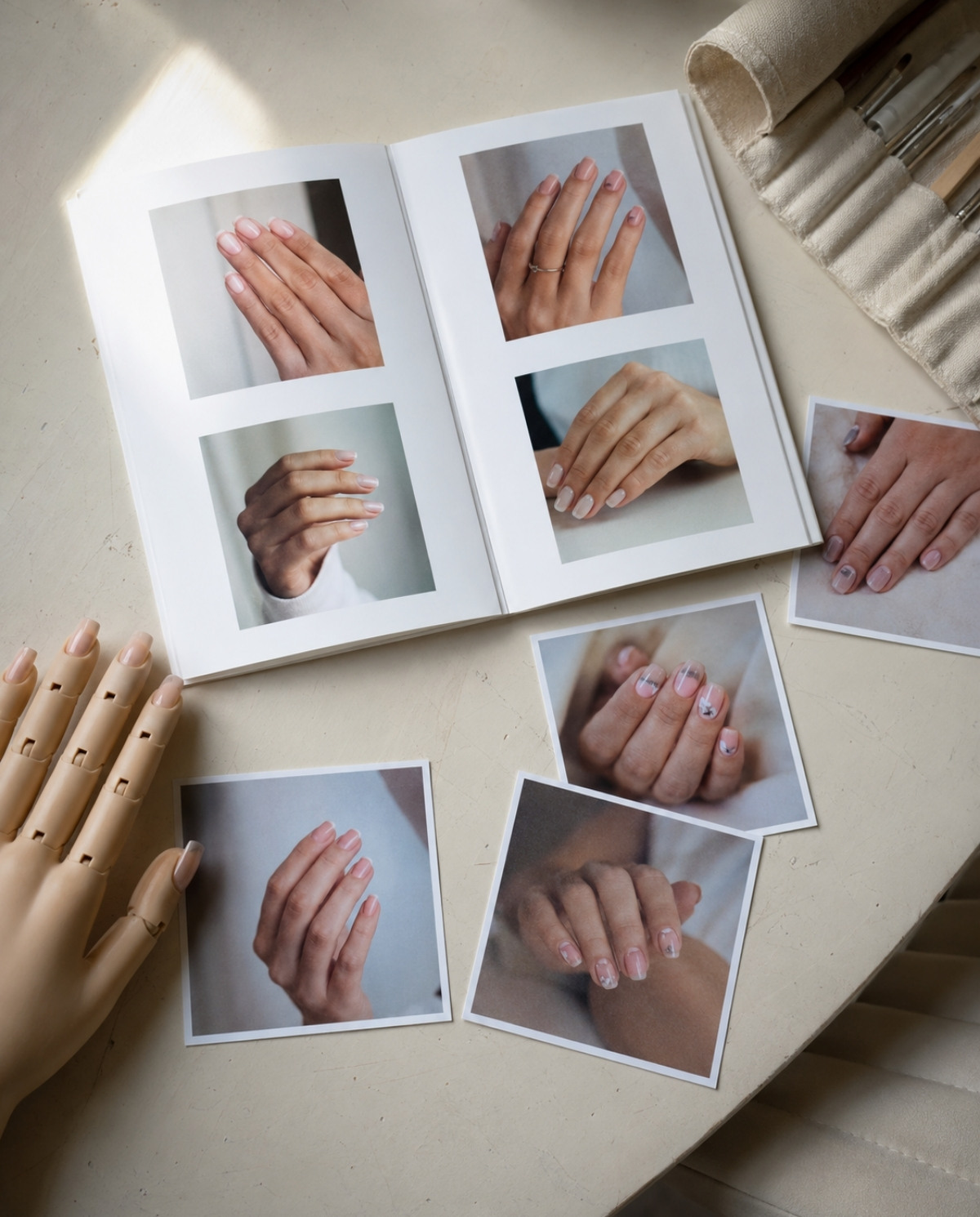
Overhead view of manicure portfolio photos, a practice hand, and nail tools arranged on a neutral desk.

A resume with no salon job history should never feel empty. Instead of filling it with vague lines, use it to prove that you already have the foundation a salon owner wants to see. A strong CV for a nail technician without experience should focus on training, licensing progress, clinic practice, sanitation knowledge, and the professional habits you built before applying.

A modern nail technician CV with no experience should show technical promise, not just past employment. Include your completed program, license status, total training hours, clinic floor experience, sanitation training, and any extra workshops or practice areas you completed, such as e-file bit safety, gel application, acrylic fundamentals, or structured manicure work. To organize your skills more clearly, you can review our guide to core procedures and essential tools and compare your resume to the practical abilities salons often expect from new technicians.

Your resume should also include a simple portfolio link. It does not need to be huge. A clean Instagram page, a Google Drive folder, or a basic digital portfolio with bright photos can show that you understand nail shape, prep, polish control, and clean presentation. For a beginner, a small nail technician portfolio that looks organized can be stronger than a long resume filled with unrelated details.

Use Transferable Work Experience the Right Way

If you have worked in retail, food service, hospitality, office support, or any customer-facing role, you already have experience that can matter in a salon. Salon owners want people who can speak to clients clearly, stay calm during busy hours, manage time, handle payments, suggest services or products, and keep clients comfortable.

For example, if you worked as a barista, do not reduce the job to “made coffee.” A stronger line would be: “Managed high-volume customer orders under tight time constraints while maintaining strict health and safety protocols.” If you worked in retail, highlight product recommendations, customer questions, checkout accuracy, and problem-solving. These details show that you understand the service side of beauty work, which can make you feel like a lower-risk beginner hire.

Your opening profile should also be specific. A strong objective for nail technician applicants should quickly show your safety mindset, interest in growth, and ability to work within a salon team. For example: “Licensed Nail Technician eager to bring strong sanitation habits, modern gel-system knowledge, and client-first hospitality to an entry-level role at a growing salon.”

What the Job Outlook Means for Beginners

New technicians sometimes assume that every opening is already taken by experienced nail artists. However, the U.S. Bureau of Labor Statistics projects employment for manicurists and pedicurists to grow 7% from 2024 to 2034, which is faster than the average for all occupations.

The BLS also projects about 24,800 openings each year on average over that decade. Many openings are expected to come from workers transferring to other occupations or leaving the labor force, including retirement. This does not mean every salon will hire any new graduate immediately, but it does show that trained and licensed applicants still have room to enter the field when they present themselves professionally.

The BLS lists the median hourly wage for manicurists and pedicurists at $16.66 in May 2024. Real income can vary depending on the salon, location, tips, commission structure, booth rental costs, client volume, and whether the technician is an employee or self-employed. For a new technician, the first role is important not only for income, but also for building speed, repeat clients, confidence, and real salon credibility.

Write a Cover Letter That Feels Specific

Your resume explains your skills, but your cover letter explains why you are a good fit for that particular salon. When writing a personalized cover letter for nail technician openings, avoid sounding like you sent the same message to every business in town. Salon owners can usually tell when a cover letter is generic.

A strong cover letter for nail technician with no experience candidates should show genuine interest, teachability, and respect for the salon’s standards. Some owners are open to hiring beginners because they can train them according to the salon’s timing, service flow, product systems, client style, and quality expectations.

What to Include in the First Few Lines

Start by addressing the owner, hiring manager, or salon manager by name when you can. Then explain why that specific salon caught your attention. You might mention their clean work, natural nail focus, nail art style, luxury pedicure menu, strong reviews, or education-focused culture.

You should also show that you understand scope of practice. That means knowing what your license allows you to perform and where the legal boundaries are. For example, you can explain that you understand the difference between professional exfoliation and invasive skin removal, and that you only perform services on intact, healthy skin and nails within your training and state rules.

For Arkansas-based beginners, it is also smart to understand state-board expectations before interviewing. The Arkansas cosmetology rules include requirements connected to sanitation, personal cleanliness, disinfectant use, properly labeled containers, pedicure-spa cleaning, and safe storage of clean items. Mentioning that you take these rules seriously can help an entry-level applicant sound more prepared.

You can also strengthen your application by showing that you understand professional nail salon hygiene practices before you are hired. End the letter by saying you are willing to complete a practical test on a live model or practice hand so the salon can evaluate your current skill level.

Use Product Safety Knowledge as an Advantage

Modern salon owners have to think about client safety, worker safety, product claims, and compliance. According to the U.S. Food and Drug Administration, the Modernization of Cosmetics Regulation Act, known as MoCRA, expanded FDA authority over cosmetics and includes requirements such as serious adverse event reporting and safety substantiation for cosmetic products.

A beginner nail technician does not need to act like they personally carry every manufacturer-level MoCRA responsibility. The better point is that you understand the modern safety environment around professional cosmetic products. The FDA’s cosmetic registration and product listing guidance states that a responsible person must list each marketed cosmetic product with FDA, including product ingredients, and provide updates annually. This makes it even more important for salons to buy from reputable suppliers, read product labels, keep Safety Data Sheets accessible, and take client reactions seriously.

You can also stand out by knowing current ingredient warnings. For example, the FDA has warned that several cosmetic products marketed as gel nail polish removers were found to contain methylene chloride, also known as dichloromethane or methyl bichloride. FDA states that methylene chloride is prohibited in cosmetics at any level. If you know how to check labels, avoid questionable imported removers, and ask for Safety Data Sheets, you show that you care about protecting clients, coworkers, and the business.

Create a Beginner Nail Portfolio That Looks Professional

In nail care, visual proof matters. A digital portfolio can show your current ability faster than a resume can. You do not need years of paying clients to build one. You need clear photos, clean work, and enough detail to show that you understand the service process.

You can begin with practice hands, classmates, friends, family members, and school clinic work. The goal is not to show the most complicated nail art possible. The goal is to show control, consistency, sanitation awareness, and neat technique.

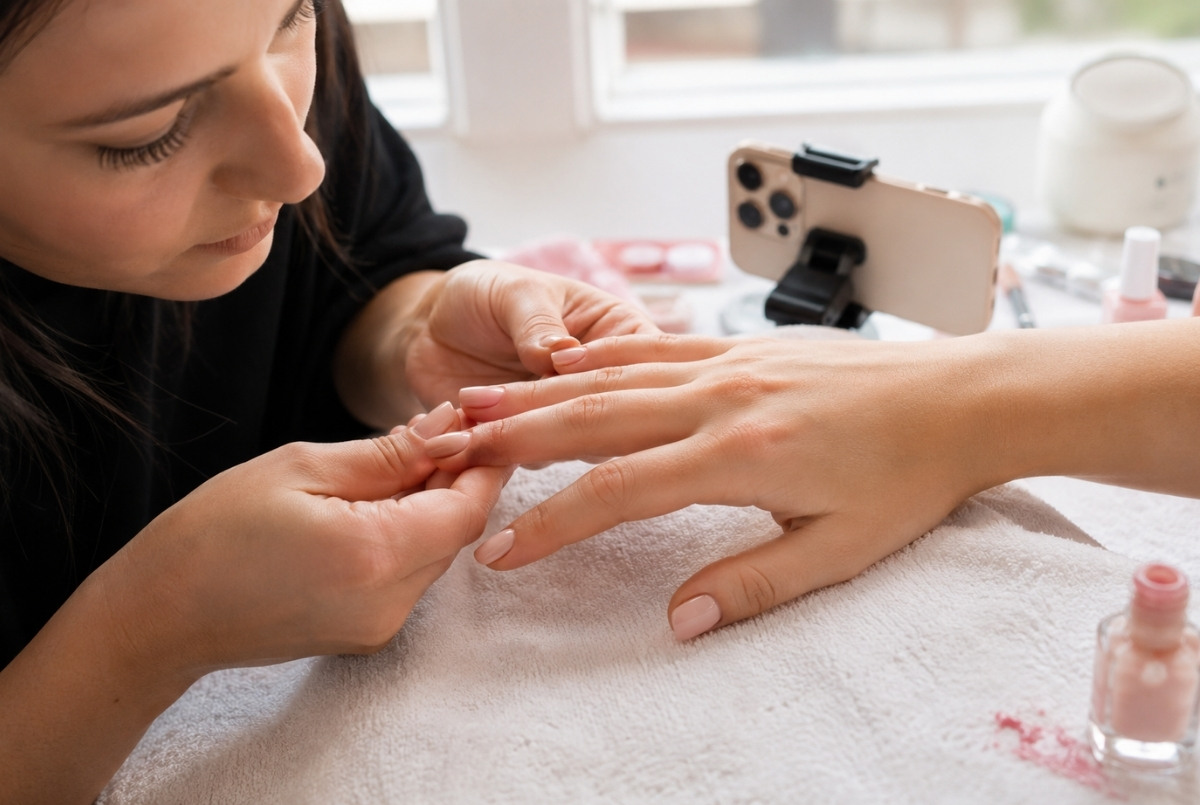
Beginner nail technician carefully checking nude polish edges on a model’s hand with a phone camera nearby.

Choose Photos That Prove Clean Technique

When photographing your work, avoid heavy filters, messy backgrounds, and distracting props. Use bright natural lighting or a clean ring light. Keep the background simple. Crop out clutter such as open containers, used files, dirty towels, or random product bottles.

Your portfolio should include several shapes, such as coffin, almond, and square. It should also show smooth polish application without flooding into the lateral nail folds. Include simple manicures along with nail art, because basic work often proves more than a complicated design with weak prep or uneven application.

For each image, add a short caption that shows professional thinking. Mention the service type, shape, product system, prep method, and whether the work was done on a practice hand or live model. A beginner portfolio feels stronger when it explains the process behind the finished set.

Add Product-System Awareness

A strong portfolio does more than show attractive colors. It also shows that you understand product systems and client safety. As discussed in a market trends analysis by Booksy Biz, modern salon conversations increasingly focus on cleaner positioning, ingredient awareness, and more specific product claims instead of vague “non-toxic” language.

Accuracy matters here. HEMA-free and TPO-free products are often marketed as ways to reduce exposure to specific ingredients of concern, but they do not make a service automatically risk-free. The FDA’s nail care product guidance explains that many nail products contain potentially harmful ingredients but may be safe when used according to directions. The British Association of Dermatologists has also warned about allergic reactions connected to methacrylate chemicals used in acrylic nails, gel nails, and gel polish.

In your portfolio captions or interview conversation, explain that you follow the manufacturer’s lamp, cure-time, product-thickness, and application instructions. Do not claim that any product is completely allergy-proof. Instead, show the habits that matter: avoid skin contact with uncured gel, cure correctly, do not casually mix incompatible lamps and gel systems, keep containers closed, and follow product instructions.

Prepare for the Salon Interview and Practical Audition

A salon interview can feel intimidating, especially when you are new. Preparation makes it easier. Before you walk in, practice common nail technician interview questions and answers so you can speak clearly instead of freezing.

Good answers should bring the conversation back to your strengths: your training, sanitation habits, client-service mindset, product awareness, and willingness to learn. If you already know how to answer tough interview questions for a nail technician with answers that sound calm and honest, you will feel more prepared in front of a salon owner or manager.

Beginner nail technician practicing interview answers in a mirror with a manicure kit, apron, portfolio folder, and disinfected tools nearby.

How to Answer the Experience Question

A salon may ask how you would handle a fast-paced environment if you have not worked in a commercial salon before.

Do not apologize for being new. A better response would be: “During my beauty school clinic floor hours, we worked under time limits to simulate a real salon environment. I learned how to manage my setup, perform a clear consultation, complete a clean service, and maintain sanitation protocols throughout the appointment. I know I still need to build speed, but I already understand how to stay organized, safe, and coachable under pressure.”

If the salon asks for a practical audition, ask in advance what they want you to bring. If you bring your own tools, make sure reusable implements are cleaned, disinfected, dried, and stored in a clean covered container according to state-board rules. Keep clean tools away from used tools. Do not reuse porous single-use items such as certain files, buffers, orangewood sticks, or toe separators unless your state rules and product instructions clearly allow proper disinfection.

For Arkansas applicants, remember that sanitation rules are not just theory. The Arkansas cosmetology rules cover important expectations such as personal cleanliness, disinfectant use, labeled containers, clean storage, and pedicure equipment sanitation. During the audition, explain your steps as you work. Show how you protect the natural nail plate, avoid overfiling, reduce cross-contamination, and keep the station clean. Figuring out how to get a job as a nail technician is strongly connected to how safely you perform under pressure.

Set Up a Safer Workstation

One serious workplace concern for nail technicians is repeated exposure to dust, vapors, and chemical ingredients, especially in poorly ventilated salons. The Occupational Safety and Health Administration advises salon workers and employers to choose safer products, read product information, use appropriate gloves, avoid surgical masks for chemical protection, and rely on good ventilation and work practices to reduce exposure.

Ventilation can also be part of building-code requirements. The International Code Council explains that the International Mechanical Code requires source-capture systems at manicure and pedicure stations, with a minimum exhaust rate of 50 CFM at each station and exhaust inlets located close to the point of chemical application when factory-installed inlets are not provided. Requirements can vary by jurisdiction and salon build-out, so ventilation should be treated as both a worker-safety issue and a local-code issue.

During a salon walkthrough or practical test, respect the setup around you. Use closed product containers, keep waste controlled, pay attention to downdraft tables or source-capture systems, and avoid messy station habits. These details show that you are not just trying to get hired quickly. You are trying to become a professional who protects clients, coworkers, and your own long-term health.

Ready to Begin Your Nail Career?

A strong beauty career starts with training that gives you confidence in both technique and professionalism. If you are trying to move from practice work into real salon opportunities, the right school environment can help you build the habits employers want to see: clean service flow, sanitation discipline, client communication, and steady hands-on practice.

At Career Academy of Hair Design, students can explore beauty training options designed to help them build practical skills for the professional salon environment. To learn more about upcoming start dates, schedule a personal campus tour, or connect with the admissions team, visit the Enrollment page. You can also leave your details in the contact form below this article, and the team can help you understand your next step.

Frequently Asked Questions

Do I need a nail technology or cosmetology license before working in a salon?

Yes, in most situations, you need a valid state-issued license before performing manicures, pedicures, and nail enhancement services for compensation. The U.S. Bureau of Labor Statistics explains that manicurists and pedicurists must complete a state-approved cosmetology or nail technician program and pass a state exam for licensure.

Requirements are not identical in every state. Arkansas, for example, includes a 600-hour manicure curriculum in its cosmetology rules. That is why beginners should confirm current state-board requirements before assuming one pathway applies everywhere. A dedicated beauty school pathway remains one of the clearest ways to build training hours, sanitation knowledge, and state-board readiness.

How are entry-level nail technicians usually paid?

Entry-level pay structures often fall into three categories: hourly pay, commission, or booth rental. For a beginner with no existing client base, hourly pay plus tips is often the safest starting point because it gives you more stability while you build speed, confidence, and repeat clients.

Commission and booth rental can become better options later, but they usually require strong rebooking habits, regular clients, and a clear understanding of product costs and business expenses. According to the BLS, the median hourly wage for manicurists and pedicurists was $16.66 in May 2024, but real take-home income can vary based on location, tips, service pricing, schedule, salon model, and employment structure.

Can someone work as a nail technician while pregnant or dealing with breathing sensitivities?

Many people can work in nail care while pregnant or managing respiratory sensitivities, but they should take exposure seriously and speak with a healthcare professional about their specific situation. Better ventilation, closed product containers, appropriate nitrile gloves, source-capture dust control, and careful product choices are more reliable than depending on a basic mask alone.

The OSHA nail salon chemical hazard guidance warns that surgical masks do not protect workers from gases, vapors, or particulates. OSHA also explains that NIOSH-approved N95 respirators can help with particulates such as dust from buffing or filing, but they do not protect against chemical vapors or gases. If vapor protection is required, the employer must evaluate exposure and follow OSHA respiratory-protection requirements, including correct respirator selection, medical evaluation, fit testing, and training.

Mastering Nail Technology: Nail Salon Hygiene and Professional Aftercare Advice

The nail industry has reached a point where client expectations are shifting toward health-conscious results. Beautiful art is still a big draw, but the hidden standards of safety are what really build a loyal following. Modern luxury in 2026 is defined by how well a technician handles the biological side of the job while creating a great look. Focusing on these details makes you a true expert rather than just a service provider.

I believe that moving from a beginner to a professional requires a mindset shift from simply decorating nails to actively protecting them. If you are just starting out, checking out this 2026 guide to your new career is a smart way to get a handle on the industry basics. Giving your clients professional aftercare advice for nail technology is one of the most effective ways to build a name for yourself. This level of care turns you into a trusted consultant who understands how the nail plate actually works.

Essential Points for the Modern Professional

  • Knowledge of Microbiology: Staying safe starts with the ability to identify the four types of organisms (bacteria, fungi, viruses, and parasites) that can impact your workspace.
  • Understanding Tech Limits: Salon UV lamps and standard lasers are helpful tools, but they are not medical cures for infections.
  • Advanced Credentials: Earning a medical nail technician certificate helps you stand out and allows you to work safely with higher-risk clients.
  • Effective Aftercare: The market is moving toward products like functional patches and pens that target the nail matrix for better healing.

The Science of a Clean Workspace

A detailed view of a tidy manicure workstation, with a human hand resting on a grey mat next to a tray of sterilized tools, a folded white towel, blue gloves, a sanitizer pump, and a potted plant.

The first thing I learned in this industry is that the most important work happens before the polish ever touches the nail. We often talk about the “bio-burden,” which refers to the amount of bacteria and germs living on a surface or tool. To manage this effectively, you must be able to list the four types of organisms that are pertinent to nail technology: bacteria, fungi, viruses, and parasites.

Learning these categories helps you understand how germs behave in the warm, damp environment of a salon. Fungi are especially tricky because they love the dark spaces created when a nail enhancement begins to lift away from the natural nail. Proper infection control requires mechanical debridement, which is the physical act of cleaning away the sticky layer of bacteria before you even start using chemicals. According to the 2026 Sunset Review Report by the California Board of Barbering and Cosmetology, skipping these steps is a major cause of infections like ringworm, even in high-end shops. Clinical-grade habits will always be more important than expensive decor.

What You Need to Know About High-Tech Treatments

Clients today are very curious about the latest medical gadgets. I often get questions about whether new technology can actually solve health issues. A very common question is: does UV technology kill nail fungus in a salon setting?

A professional nail technician uses a pointer tool to explain nail health to a client at a modern manicure station featuring a curing lamp and a printed guide.

The Reality of UV Lamps

The short answer is that salon lamps are built to dry polish, not to cure infections. While medical-grade UV technology that fights nail fungus does exist, it uses much higher intensities and different wavelengths than our curing lights. Using gel polish over an active infection can actually make things worse by trapping moisture and creating a space where fungus thrives. As mentioned in the Infection Control Guidelines from CT.gov, UV boxes are only meant for storage and are not enough for full sterilization.

Laser Technology and Expectations

I also hear people asking if laser technology works on nail fungus consistently. Based on the Medical Policy SURG.00138 from Healthy Blue Louisiana, lasers are mostly used to assist other treatments. They use heat to slow down the fungus, but they rarely provide a total cure on their own. Knowing the limits of laser technology for nail fungus helps you guide your clients to the right medical help when they need it.

Taking Care of Nails Between Appointments

The time between salon visits is when the real maintenance happens. If a client doesn’t protect the natural fatty acids in their skin and nails, your hard work in the salon won’t last as long. Regular lotions often struggle to get through the tough surface of the nail, which is why I suggest more specialized solutions.

Modern Solutions for Better Healing

For clients who need deep repair, I recommend using fungal nail patches with hydrogel technology. These patches hydrate the area and allow the keratin to soften so that protective ingredients can reach the nail bed more effectively. I also suggest a daily routine with a nail care pen featuring nail matrix technology. These pens deliver nutrients directly to the area where the nail actually grows, ensuring a strong foundation for future sets.

Choosing the Right Tools for Home

Even the brushes your clients use at home can make a difference. I suggest using a Salmon hygiene technology nail brush instead of porous wooden ones. These specialized tools have resin-set bristles that help resist bacterial buildup, so the client stays clean while scrubbing under the edges of their nails. Data from Research Nester (2026) shows that the market for these functional products is growing fast as people look for science-backed wellness options.

Advancing Your Career as a Specialist

A professional woman in a sage green apron stands in a bright, modern studio holding a wooden clipboard and smiling.

Getting your basic license is the first step, but specialized training is what really sets you apart. If you want to work with higher-paying clients or those with health needs like diabetes, earning a medical nail technician certificate is a fantastic goal. This lets you move into more advanced care and can even qualify your business for a Healthy Nail Salon Recognition Program. Joining a Healthy Nail Salon Recognition Program shows your community that you prioritize safety and clean air.

The FDA’s 2026 General Wellness Framework has made it clear that professionals must be careful with the claims they make. Having official certifications is the best way to prove your high standards. To learn more about the specific skills and tools you need to succeed, I suggest reading this guide to professional procedures and tools.

Start Your Professional Journey with Career Academy of Hair Design

I believe that choosing the right place to train is the biggest decision you will make for your future. At Career Academy of Hair Design, we focus on helping you become a leader in the industry by mastering both the art and the science of the job. Our approach ensures that you graduate with a deep understanding of the hygiene and aftercare techniques that the top salons are looking for in 2026.

The future of this field belongs to specialists. Whether you want to open your own boutique or work with high-tech brands, we provide the foundation you need to stand out. You can find out more about how to get started in our Enrollment section. If you have questions or want to see the campus for yourself, please fill out the contact form at the end of this article. I look forward to seeing where your career takes you!

FAQ: Common Tech and Safety Questions

Can I use a standard LED salon lamp to treat a fungal issue?
No, I wouldn’t recommend that. While there is UV technology for nail fungus used in clinics, salon lamps are only designed to harden polish. They don’t have the strength needed to kill fungal spores.

What is the main benefit of nail matrix technology?
Standard oils often stay on the surface of the skin. A pen designed with this technology reaches the growth center of the nail, supporting the formation of healthy new cells from the start.

Why should my salon join a Healthy Nail Salon Recognition Program?
Being part of a Healthy Nail Salon Recognition Program is a great trust signal. It shows clients that you follow strict safety protocols and care about their well-being, which is a major advantage in today’s market.

Mastering Nail Technology: A Professional Guide to Core Procedures and Essential Tools

I remember when I first started exploring the beauty industry; I honestly thought being a nail technician was all about artistic flair and steady hands. It didn’t take long for me to realize that the real pros are actually masters of science and structural engineering. In 2026, the shift toward medical-grade services means we have to be more careful than ever about chemical safety and structural integrity.

If you are currently trying to figure out where you fit in this evolving landscape, I suggest taking a look at this 2026 guide to your new career to see how the industry is changing. According to recent data from Business Research Insights, nearly a third of clients now report sensitivities to traditional salon chemicals, so establishing yourself as a health-conscious specialist is a very smart move.

Key Industry Shifts For 2026

  • Market Evolution: The nail sector is projected to hit $122.7 billion by 2035, largely driven by a demand for skin-first and medical-grade services.
  • Regulatory Compliance: Under the latest MoCRA updates, you must understand product chemistry to navigate new FDA safety standards and recall powers.
  • Structural Mastery: Success today centers on builder-in-a-bottle (BIAB) systems and precision e-filing rather than heavy, traditional acrylics.
  • Clinical Care: Bioactive ingredients like calcium silicate are clinically proven to increase nail thickness by 39%, moving our role from artist to health consultant.

A professional nail technician workstation with a UV lamp, an electric file, and stainless steel tools on a clean tray.

The 2026 Starter Kit Checklist

I know that the startup cost and the time commitment for a new career can feel a bit overwhelming. To help you plan, I recommend reading about the licensing path and professional requirements so you have a clear financial roadmap. When you are ready to assemble your nail technology kit, I find it easiest to organize your purchases into four main pillars.

First, you have Equipment, which includes permanent assets like UV/LED lamps and high-torque electric files. Then you have Implements, which are multi-use steel tools like nippers and pushers. Next are Materials, which are the consumables like files, buffers, and wipes. Finally, there are the Professional Products, which cover the chemistry side – dehydrators, primers, and gels.

When people ask me what do beginner nail techs need, I always emphasize that their own health should be the priority. Your list of things for nail techs should definitely include a high-quality dust extraction system with a HEPA filter. In 2026, I consider this a critical requirement for a long and healthy career.

Defining The Tools Nail Technicians Use

A common mistake I see beginners make is spending too much money on trendy polish colors while neglecting the workhorse tools that actually generate revenue. It is important to distinguish between your daily operating costs and your long-term capital investments.

Top-down photo of a nail tech starter kit with a UV lamp, electric file, metal tools, and gel bottles arranged on a clean wooden desk.

What Are Permanent Items Known As?

In a professional curriculum, you will often encounter the question: what are permanent items utilized in nail technology known as? These are officially categorized as Equipment and Multi-use Implements. Unlike disposables, these items represent your long-term infrastructure. High-quality stainless steel nippers and 48W+ UV/LED lamps are the backbone of your station. I always suggest investing in autoclave-ready steel to meet the clinical sanitation standards of 2026.

Specialized Hygiene And Modern Standards

Sanitation has moved way beyond a quick soak in blue liquid. High-performance nail technology tools, such as the Salmon Hygiene Technology nail brush, are now staples because their bristles are designed to resist bacterial load. Using these kinds of specialized tools nail technicians use is the fastest way to show a client they are in safe, professional hands.

The Impact Of MoCRA 2026

According to the FDA’s MoCRA updates, brand knowledge is now a legal safety requirement. In 2026, the FDA has mandatory recall authority, meaning your education regarding the products used in nail technology is a legal necessity for professional practice.

The Architecture Of Professional Extensions

To be a high-end technician today, you have to create extensions that look virtually indistinguishable from natural nails while remaining structurally sound. This requires mastering the C-curve and the Apex, which are the pillars of professional nail technology procedures.

The C-curve is the horizontal arch of the nail when viewed from the tip, providing the structural vault needed to prevent the nail from being too flat. The Apex is the highest point of the nail from a side view. It serves as the reinforcement zone; by placing the bulk of your product here, you ensure the nail can absorb daily impacts without cracking.

Mastering Nail Forms

Learning how to put a nail form on correctly is an essential skill for any student. Unlike plastic tips, a form allows you to sculpt a custom extension based on the specific geometry of the client’s finger. Knowing how to put nail form templates flush against the skin prevents the structural failure that leads to painful breaks. If you have ever wondered how do you put on a nail form for the best results, it all comes down to that perfect fit against the hyponychium.

Once the form is set, the material you choose is critical. Many professionals now favor specialized products like diva nail technology builder gel. These structured manicures are driving higher service prices because they protect the nail’s natural lipid barrier while providing incredible durability.

Macro side view of a nail artist shaping a clear gel extension over a pink paper guide on a client's finger.

Precision Technology And Bioactive Science

The electric file is often the most misunderstood part of any nail care nail equipment list. When I teach someone how to use an e-nail, I explain that we aren’t drilling into the nail; we are actually performing a very fine micro-exfoliation. Using diamond bits at low speeds allows you to clean the lateral folds with surgical precision, which makes your gel application last much longer.

Strengthening The Natural Nail Bed

We are currently in a skin-first era of nail care. I am a big fan of systems like OPI Nail Envy with Tri-Flex technology because they mimic the natural keratin structure of the nail. By understanding how the Triflex technology creates a flexible shield and how a nail care pen with nail matrix technology supports the growth center under the cuticle, you can offer truly restorative services.

Whether you are using OPI Nail Envy original strengthener with Triflex technology or OPI Nail Envy Tri-Flex technology, you are helping clients rebuild their nail health from the root up. These treatments, including the OPI nail strengthening treatment with Tri-Flex technology, are vital for helping clients recover from damage caused by improper techniques.

The Evolution Of Press-On Nails

If you think press-ons are just for home use, you would be surprised. In 2026, professional press-on nail technology has turned these into high-end, custom-painted sets. Understanding what are nail press-ons in a professional context allows you to generate income even when you aren’t physically at your desk.

A 2025 clinical evaluation published by MDPI proved that bioactive formulations can increase nail thickness by 39% in just 28 days. When you can explain the reason behind the nail technology products you use, you transition from a service provider to a nail health consultant.

Aftercare Advice And Career Growth

My work doesn’t stop when the top coat is dry. The most successful technicians provide detailed aftercare advice for nail technology that focuses on managing mechanical stress. If I can teach my clients not to use their nails as tools, my work stays pristine, leading to the five-star reviews that grow my career.

The market is moving fast, and there is a massive opportunity for specialists who understand these advanced nail tools and uses. By choosing a path that emphasizes quality and safety, you are positioning yourself for success from day one.

Start Your Professional Journey

The move toward health-focused and medical-grade services is a huge opportunity for anyone starting out right now. At NWA Beauty Academy, I see every day how a salon-ready approach helps students prepare for the real world. We make sure you get hands-on experience with the same professional tools and products used in nail technology that top-tier salons expect you to know.

If you are ready to see what your future could look like, I invite you to find out more in Enrollment. You can also reach out through the contact form we’ve left at the end of this article to ask questions or schedule a time to visit us. I look forward to helping you build something beautiful.

FAQ: Mastering Your Nail Technology Tools

What do nail techs use for professional work versus home care?
Professional gear is much more powerful and precise. In school, you learn to use high-torque e-files and LED lamps with specific wavelengths that ensure the gel is fully cured, which is essential for preventing the allergies often caused by weak, consumer-grade equipment.

How do I choose the best tools used in nail technology for my kit?
I always suggest sticking to a consistent system. Using the base, color, and top coat from the same brand ensures the chemical bonds are compatible, which stops the nails from peeling or lifting too early.

What tools do you need to be a nail technician in a medical-grade salon?
You will need specialized nail technology tools including an autoclave for sterilization, professional-grade e-file bits, and a kit that focuses on hypoallergenic products to keep your clients safe from irritation.

Do You Need a Certificate to Be a Nail Technician? Understanding the Path to Professional Licensure

I have spent a lot of time watching the beauty industry evolve, especially as we move through 2026. It is a common sight lately to see talented artists creating incredible designs in their spare time and wondering if they could turn that passion into a full-time career. Transitioning from a hobbyist to a professional in the nail world is an exciting move, but it involves more than just having a steady hand for intricate art. Understanding the legal side of things is the first step toward building a business that can actually last. If you are just starting to look into this path, I recommend checking out this 2026 guide to your new career to get a feel for the current landscape before we get into the specifics of requirements and costs.

Key Takeaways for 2026

  • The Credential Gap: Finishing a course gives you a certificate, but only a nail technology license gives you the legal right to charge for your services.
  • Client Expectations: About 22% of clients now actively look for professionals with verified medical-grade sanitation training.
  • Modern Regulations: The full implementation of MoCRA this year means every tech needs a deeper understanding of product chemistry and safety.
  • Arkansas Standards: For those of us here in Northwest Arkansas, the state requires a specific set of training hours to qualify for the board exam.

A focused nail trainee practicing filing on a mannequin hand at a wooden desk equipped with a lamp, open study workbook, and professional manicure tools in a bright, neutral-toned beauty school classroom.The Legal Foundation: Why a Certificate Isn’t Enough
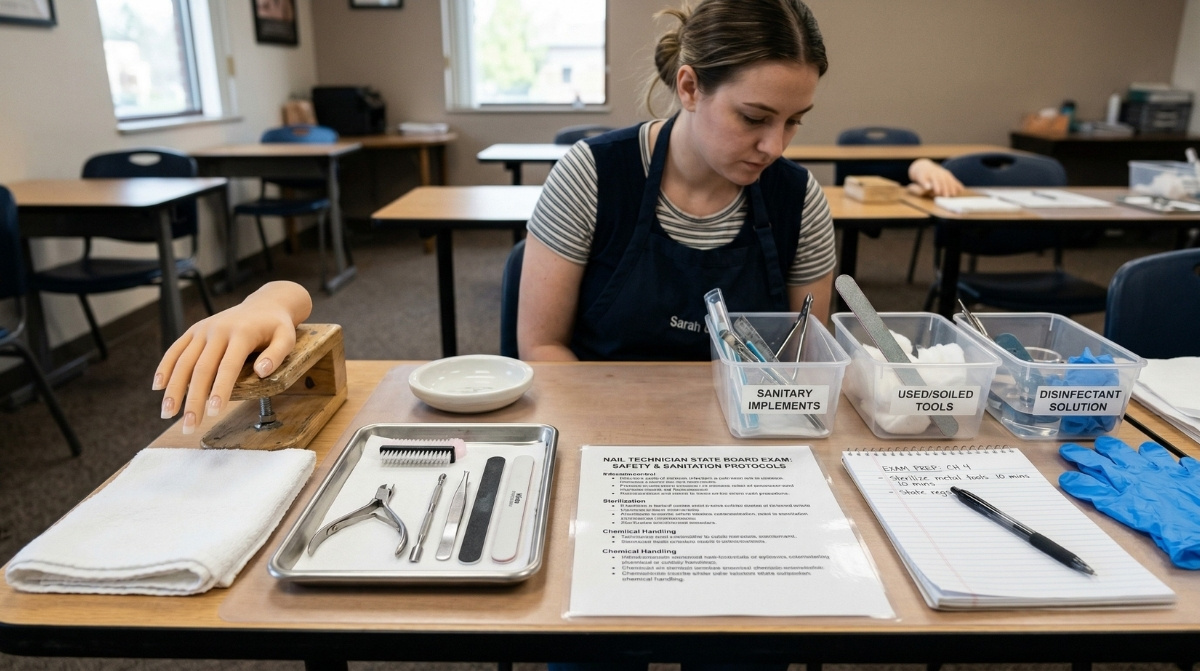

I often see new students get confused about the terminology when they start their research. One of the biggest hurdles is realizing that a diploma from a workshop is not a permit to work in a salon.

Education vs. Licensing

If you are asking yourself do I need a certificate to be a nail technician, the answer is that you need a specific type of education that leads to a license. While a nail technician certificate proves you learned the skills, a state-issued license is what keeps you legally compliant with health codes. In 2026, having that license is more valuable than ever because of the Interstate Cosmetology Compact. This initiative is great because it helps licensed pros move between participating states without the headache of starting their education all over again.

The 2026 Safety Shift

The federal government has become much more involved in our industry recently through the Modernization of Cosmetics Regulation Act (MoCRA). I have noticed that the U.S. Food & Drug Administration is now holding professionals to a higher standard regarding the chemicals and polymers we use every day. To stay safe and legally protected, you need to be more than just an artist; you have to be a safety-conscious professional who understands the science behind the products.

The Educational Journey: Training and Testing

Choosing a nail technology program is probably your first major career decision. I always suggest that people compare a specialized nail tech program against a cosmetology license to make sure they are picking the path that actually matches their goals.

Here are the SEO-optimized text elements for your image, designed to enhance searchability for educational and professional beauty industry contexts.

Clock Hours and Training Models

So, how long is a nail program? Here in Arkansas, you are looking at a requirement of 600 hours of training. If you are a full-time student, I usually see people finish in a few months, while part-time students might take a bit longer. When people ask me how long it takes to train as a nail technician, I remind them that it is not just about the hours; it is about building the muscle memory for the job.

I also get questions about a nail technician apprenticeship. While some states allow this, it usually takes much longer than a traditional nail technology program, and you might miss out on the structured theory classes that are so important for passing the nail technology exam.

Getting Ready for the State Board

To get through the final testing phase, I recommend using a nail technology state board practice test that mimics the current 2026 format. The exams this year are very focused on chemistry and blood exposure protocols, so you want to make sure your nail technology school is giving you the right tools to prepare for the final boss of your education.

The Financial Side: What to Expect

I know that the question of how much is nail technology school can be stressful. When I talk to prospective students, I always emphasize looking at the total cost of attendance rather than just the tuition.

Planning Your Budget

A good manicuring school will be transparent about what you are paying for. You should factor in your tuition, your professional kit, books, and any registration fees. Having a high-quality kit from day one is essential because you need professional-grade tools to learn professional-grade skills.

There are several ways to help manage the nail program cost in 2026:

  • Federal Assistance: The Department of Education has been working on the Workforce Pell framework, which is designed to help people access short-term career training.
  • Industry Scholarships: I always tell my readers to look into groups like Beauty Changes Lives, which offers several scholarships for nail technology students.
  • Flexible Payments: Most schools offer internal payment plans to make the transition into a new career more manageable for your monthly budget.

The 2026 Career Outlook and Earning Potential

A licensed nail technician in grey scrubs carefully provides a professional manicure to a client at a clean, organized wooden workstation inside a modern, bright salon with minimalist decor.

The current market is very rewarding for those who take the time to get their nail technology license. Data from Business Research Insights shows that clients are willing to pay a premium for safety and expertise.

According to Indeed’s data from March 2026, the earning potential is looking strong:

  • The national average base pay is currently around $23.68 per hour.
  • Top-tier professionals in specialized or luxury markets are seeing rates as high as $50.73 per hour.
  • In some high-demand boutique areas, specialized rates have even been reported reaching nearly $95 per hour.

It is important to remember that these numbers are just the base pay. Once you add in tips and commissions, your actual take-home pay can be significantly higher.

Building Your Future in Beauty

I have seen so many people change their lives by taking this step. At Career Academy of Hair Design, we focus on making sure you are ready for the real world. We have been part of this industry for over 20 years, and I can tell you that the right foundation makes all the difference when you are trying to build a professional legacy.

We focus on helping you bridge the gap between being a student and becoming a professional who can command top rates. Whether it is mastering safety standards or learning how to manage your own books, the goal is to give you total sovereignty over your career. I invite you to come visit our campus and see the energy of our clinic floor for yourself.

If you are ready to take that next step, you can find more information about how to get started on our Enrollment page. We also have a contact form at the bottom of this article if you have any specific questions for us!

FAQ: People Also Ask

What is the difference between a Level 2 and Level 3 nail technician certificate? Usually, a Level 2 certificate covers the basics of enhancements and standard service, while Level 3 moves into advanced chemical composition and master-level technical skills.

Can I go to nail school online in 2026? You can find hybrid programs that let you do your theory work online, but you will still need to complete your hands-on hours in a physical school to qualify for your license.

Is the Interstate Compact active everywhere? It is a growing initiative in 2026 that allows licensed professionals to work in multiple participating states more easily. It is a huge benefit for anyone who might need to move for their career.

Nail Tech Program vs. Cosmetology: Understanding the Key Differences for Your Future

Starting a career in the beauty industry is an exciting move, but I know it can also feel a bit overwhelming when you’re trying to figure out which license actually fits your goals. Are you someone who wants to be a master of everything beauty-related, or do you have a specific eye for detail that draws you toward one craft? In 2026, being successful in this field is all about technical skill and a solid understanding of professional standards, so picking the right education path is the first real step in building your brand.

Whether you’re dreaming of opening a high-end studio or working behind a chair in a busy salon, the choice between a cosmetology or nail technician program really comes down to how you want your daily work life to look.

Key Takeaways for Your Career

  • Speed to Market: If you’re looking to start earning quickly, a nail technology program is often the fastest route. In Arkansas, this requires 600 hours of focused training.
  • Market Resilience: The demand for specialized nail services is booming, with a 10.7% CAGR that shows no signs of slowing down (Technavio, 2025).
  • Safety and Standards: Professional schooling is vital for learning chemical safety and sanitation. With new federal oversight like MoCRA, staying compliant is a major part of being a reliable professional.
  • Specialization Payoff: Focusing on a niche often allows you to command higher prices and build a more loyal client base.

A side-by-side editorial comparison of a cosmetology student styling hair and a nail technician performing detailed nail art in a modern, luxury salon setting.

Defining Your Scope: Generalist vs. Specialist

When I talk to prospective students about the difference between cosmetology and nail technology, I always suggest looking past the services and looking at the lifestyle.

Cosmetology is the broader path. In Arkansas, it involves 1,500 hours of training that covers hair, skin, and nails. I think of this as the ultimate versatility license. It gives you the freedom to change your service menu whenever you want, whether you’re focusing on hair color one year or skincare the next. You get a deep education in the chemistry of hair and the physiology of the skin, making you a well-rounded expert.

On the other hand, a nail technology program is a 600-hour deep dive. You spend your time mastering everything from nail anatomy and product chemistry to advanced artistry and infection control. If you want to see exactly what you’ll be learning in the classroom, you should check out this 2026 guide to your nail technology career, which explains how to get started in the craft.

Expert Insight: The 2026 Regulatory Shield

Beauty professionals are seeing more federal oversight than ever thanks to MoCRA. This law requires manufacturers and distributors to report serious adverse events to the FDA. Meanwhile, OSHA still requires salons to keep Safety Data Sheets for any hazardous chemicals on hand. A professional education helps you navigate these rules so you can protect both yourself and your clients.

The Artist Identity: Credential vs. Career Branding

I believe there is a big difference between being a nail technician or nail artist. Your license gives you the legal right to work, but your branding is what determines your success.

In a professional nail tech program, you don’t just learn how to apply product; you learn the technical reasons why things work. You’ll study how to protect the structural integrity of the nail and how to work with chemicals safely to avoid long-term damage. While a technician provides a standard service, an artist provides a transformation that keeps clients coming back.

For those who prefer the wider range of a cosmetology license, the opportunities go far beyond the salon chair. You can explore careers you can have with a cosmetology license that include things like editorial styling, film work, or becoming a brand educator.

The ROI of Time: Launching Your Business Faster

If your main goal is to get into the workforce as fast as possible, the nail technology program is the clear winner. Because it’s a shorter program, you can often be licensed and working in less than six months. This is a great option for entrepreneurs who want to open their own suite or boutique without committing to a year of school.

However, the variety you get with cosmetology acts as a career safety net. Even if one part of the industry slows down, you have the skills to pivot into another area. It’s all about whether you want to be a specialist or a versatile pro.

A professional beauty expert sitting at a desk planning her career path, featuring a nail technician workspace on one side and cosmetology tools with business textbooks on the other.

Expert Insight: The $9.48 Billion Growth Trend

We are seeing a major trend toward “premium” services right now. According to Technavio’s 2025-2029 Nail Salon Market Report, the specialized nail market is growing at a 10.7% CAGR. Clients are increasingly moving away from general salons in favor of specialty boutiques where they know they are getting expert care.

The Rise of Wellness and Clinical Care

A major factor that sets a professional education apart in 2026 is the focus on nail health. While DIY kits are everywhere, they don’t teach the biological foundation needed to keep nails healthy.

Recent studies show a growing demand for wellness-first protocols. For instance, a 2020 study in Skin Appendage Disorders found that specific strengthening formulas improved nail hardness by 26.7%. Furthermore, recent literature on Advanced Dry Manicure Techniques suggests these methods can reduce risks associated with water soaking, like nail plate expansion. Staying educated on these trends is what makes you a true pro.

A professional nail technician in a clinical salon wearing a mask and blue gloves, performing a precise manicure focused on nail health and hygiene in a sterile, modern environment.

So Which Path is Yours?

Choosing between a cosmetology or nail technician program is really a choice of where you want to focus your energy.

  • Choose Cosmetology if you want to be a versatile expert who can work in hair, skin, and nails as the market changes.
  • Choose Nail Technology if you love technical details, the science of chemicals, and want to launch a specialized business quickly.

Your future isn’t just about the license you hold – it’s about the mastery you achieve.

Ready to Master Your Craft and Launch Your Legacy?

The beauty industry today needs more than just workers; it needs visionaries. At Career Academy of Hair Design, we don’t just teach you how to pass an exam – we prepare you to lead. Our training is designed to bridge the gap between the classroom and the high-end professional world, immersing you in an environment that meets the highest clinical and professional standards.

When you join us, you’re part of a 20-year legacy of excellence. We offer the mentorship you need to turn your goals into a sustainable, high-growth career.

Find Your Path

Whether you are ready to become a specialized authority or a versatile beauty expert, we have a pathway for you. You can find out more about how to get started in Enrollment. We’d love to show you our facilities and introduce you to the instructors who have been shaping beauty leaders for over two decades.

I’m here to help you take that first step. If you have questions or want to see the campus for yourself, please fill out the contact form below this article and let’s chat!

FAQ: The Professional Reality Check

What happens if I get a Nail Tech license but decide I want to do hair later?
You will usually need to go back and complete a full cosmetology program. While some hours might transfer depending on state board rules, you generally have to learn the hair-specific modules from scratch. This is why I recommend the specialist path only if you’re sure about your focus.

Is the nail market oversaturated in 2026?
The demand for quality services is actually quite high. The U.S. Bureau of Labor Statistics projects 7% growth for the field through 2034. In my experience, specialization and great client service matter far more than how many other salons are nearby.

Does a cosmetology license allow me to work in a medical spa?
It’s a great starting point, but med-spa work is very specific and often requires extra training or separate licensure for things like lasers or medical-grade devices, depending on your state’s medical board regulations.

What Are Manicuring and Nail Technology? A 2026 Guide to Your New Career

The beauty landscape has shifted significantly as we move through 2026. What might have started as a creative hobby at your kitchen table has likely turned into a serious interest in a sustainable career. The industry is no longer viewed as a basic trade; it has matured into a specialized field centered on cosmetic chemistry and the science of hand health.

When I look at what nail technology represents in the modern era, it is clear that we are talking about a high-tech, high-touch profession. Success today requires a deep understanding of human anatomy and chemical polymers. This guide is my way of introducing you to the professional side of the industry, helping you move from a talented enthusiast to a licensed specialist who can command a serious income.

Key Takeaways for Future Professionals

  • Industry Growth: This field is projected to expand by 7% through 2034, earning a Bright Outlook status because high-level manual skills cannot be replaced by AI.
  • Earning Potential: Technicians working in high-end markets are currently seeing rates between $34 and $94 per hour.
  • Safety First: Regulations in 2026 have pushed the industry toward TPO-free and HEMA-free products, making a formal education in toxicology more important than ever.

The Technical Evolution: Where Chemistry Meets Care

To understand the true meaning of nail technology today, I have to look beyond the colors and the art. Modern technicians act as surface chemists. Every service I perform involves a chemical reaction called polymerization on a living substrate. Mastering how UV light works with photoinitiators to create a strong bond without hurting the natural nail is what defines a true professional.

The Professional Role in 2026

If you have wondered what exactly a nail tech does in this new era, I think of us as the primary care providers for the hands. Beyond the aesthetic work, my role involves spotting silent health issues. A professional can see the difference between a minor bruise and subungual melanoma, or identify when a client has a fungal infection that needs a medical referral. Because of this, getting your license is a vital step for public safety.

Expert Insight: The Shift in Toxicology

According to recent updates on the New Rules of Nail Care from StyleSpeak, the global move away from TPO has created a clear line between amateurs and pros. Education in 2026 is about more than just application; it is about knowing how to read a Safety Data Sheet (SDS) to ensure the products you use are biocompatible and safe for everyone involved.

For a deeper look into these technical standards, resources like HONA’s Knowledge Hub can help you master the chemistry side of things before you even step into your first salon.

Choosing Your Path and Understanding the Economy

I find that the distinction between manicuring and nail technology is still frequently misunderstood. In most places, a manicuring license is what gives you the legal right to work. However, your training in nail technology is what gives you a competitive advantage. While basic manicuring covers general maintenance, a nail technologist is focused on engineering structures and protecting the natural nail from trauma.

Longevity for Beginners

When I talk to people starting out, I always emphasize ergonomic longevity. Many self-taught artists have to leave the business early due to physical strain or carpal tunnel. A professional program teaches you the biomechanics of your own body, such as how to hold an e-file and how to sit properly, so you can enjoy a 30-year career instead of burning out in three.

Income and Job Security

Data from the U.S. Bureau of Labor Statistics Occupational Outlook shows that this field has roughly 24,800 annual job openings. This security comes from the fact that high-dexterity roles are nearly impossible for AI to duplicate.

When looking at salary trends, recent data from Indeed shows that standard averages can be misleading. Technicians who focus on medical-grade services or architectural enhancements are finding six-figure potential in busy hubs, with specialized rates reaching between $34 and $94 per hour.

The 2026 Vision: Quiet Luxury and Technology

The dominant look of 2026 has transitioned away from loud art toward Soft Minimalism. As noted in the Vogue Scandinavia report on nail trends, a milky white shade called Cloud Dancer is the color of the year. This trend puts the focus back on natural health and clinical-grade care.

The Role of Digital Tools

Technology has become a silent partner in the salon. According to the SNS Chairs analysis of 2026 market trends, the market for nail printing and AR devices is reaching over $1 billion. Many high-end salons now use Augmented Reality to show a client the final look before the first file is even used, which leads to much higher satisfaction.

Master Your Craft at Beauty Professionals Academy

I know that understanding the future of the industry is one thing, but getting the right foundation is another. At Beauty Professionals Academy, the focus is on a salon-ready approach that prepares you to lead the market rather than just pass an exam.

The school has a 20-year legacy of helping people turn their passion into a professional career. By training in a real-world environment, you will learn the techniques that 2026 clients are actually asking for. You won’t just leave with a license; you will have a portfolio and the business skills needed to reach the highest earning levels in this industry.

If you are ready to find out how to get started, you can find more information on the Enrollment page. I also recommend checking out the contact form we have at the bottom of this article if you want to reach out and ask questions about your future in the beauty niche.

Frequently Asked Questions

Can I do medical manicuring with a standard license?
A standard license covers cosmetic work. To work in a medical capacity, you would need to pursue an Advanced Nail Technician (ANT) certification, which focuses on aseptic techniques for high-risk clients.

How long is a manicuring program in Arkansas?
In Arkansas, the state requires 600 hours of training. At Beauty Professionals Academy, we help you navigate this requirement so you can get licensed and start your career as soon as possible.

Is the market too crowded in 2026?
The low-end market is busy, but there is a major shortage of specialists who understand clean beauty and toxicology. High-end clients are specifically looking for pros who prioritize nail health.

What is the Soft Minimalism trend?
It is a shift toward perfect shaping and architectural integrity. It focuses on the C-curve and clean lines rather than complex painting, making the hand look elegant and healthy.