


Becoming a Medical Nail Technician: Training Requirements and Career Opportunities
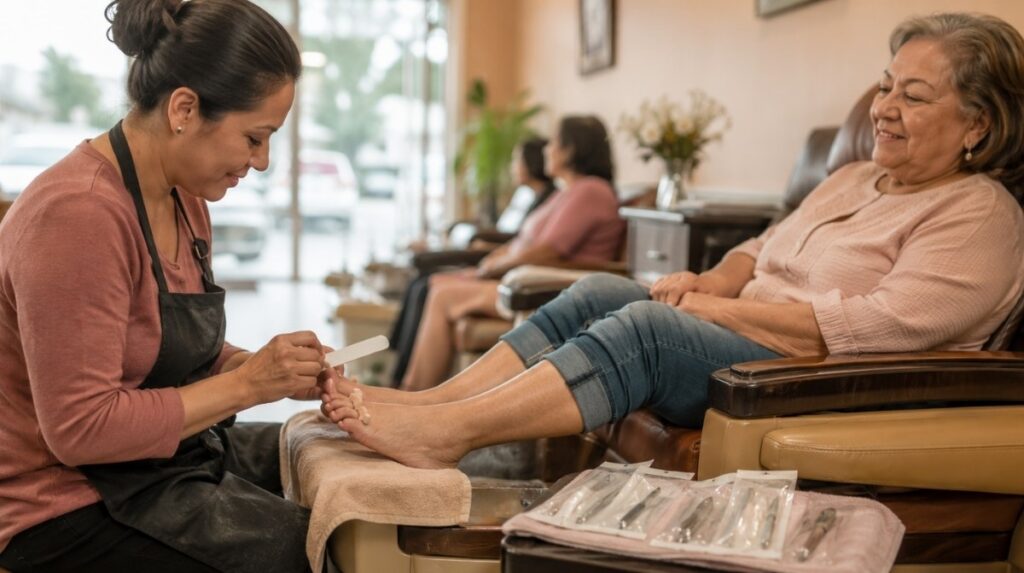
A packed appointment book is not the only direction a nail career can take. Some professionals eventually begin looking for work that places greater emphasis on careful consultations, sanitation, client screening, and deliberate service rather than speed alone.
That interest is especially relevant as more clients manage conditions that can affect their feet. The Centers for Disease Control and Prevention estimates that 40.1 million people in the United States had diagnosed or undiagnosed diabetes in 2023. Diabetes and certain vascular, neurological, immune, or mobility conditions can increase concerns involving reduced sensation, slow healing, fragile skin, circulation, and infection.
These needs have encouraged some licensed nail professionals to pursue additional safety education. Understanding how to become a medical nail technician can help you decide whether this privately certified specialty fits your career goals, while also clarifying what the credential does and does not legally permit.
What Matters Most Before You Specialize
- It Builds on an Existing Beauty License: A Medical Nail Technician, often shortened to MNT, is generally a licensed nail technician or cosmetologist who completes additional private education related to higher-risk clients, infection prevention, screening, and referral.
- It Does Not Create Medical Authority: An MNT certificate does not turn a beauty professional into a nurse, physician, or podiatrist. It does not authorize diagnosis, wound care, prescribing, or treatment of disease.
- The Credential Is Privately Issued: There is no single government-issued MNT license used throughout the United States. Course titles, prerequisites, assessments, and internship expectations depend on the certificate provider.
- Your State License Remains the Legal Limit: Services must stay within the scope of the nail or cosmetology license issued by the state where the appointment takes place.
- Income Is Not Standardized: Federal wage databases do not track Medical Nail Technicians as a separate occupation, so specialization should not be treated as a guaranteed path to a particular salary.
Where an MNT Fits Between Beauty Services and Health Awareness
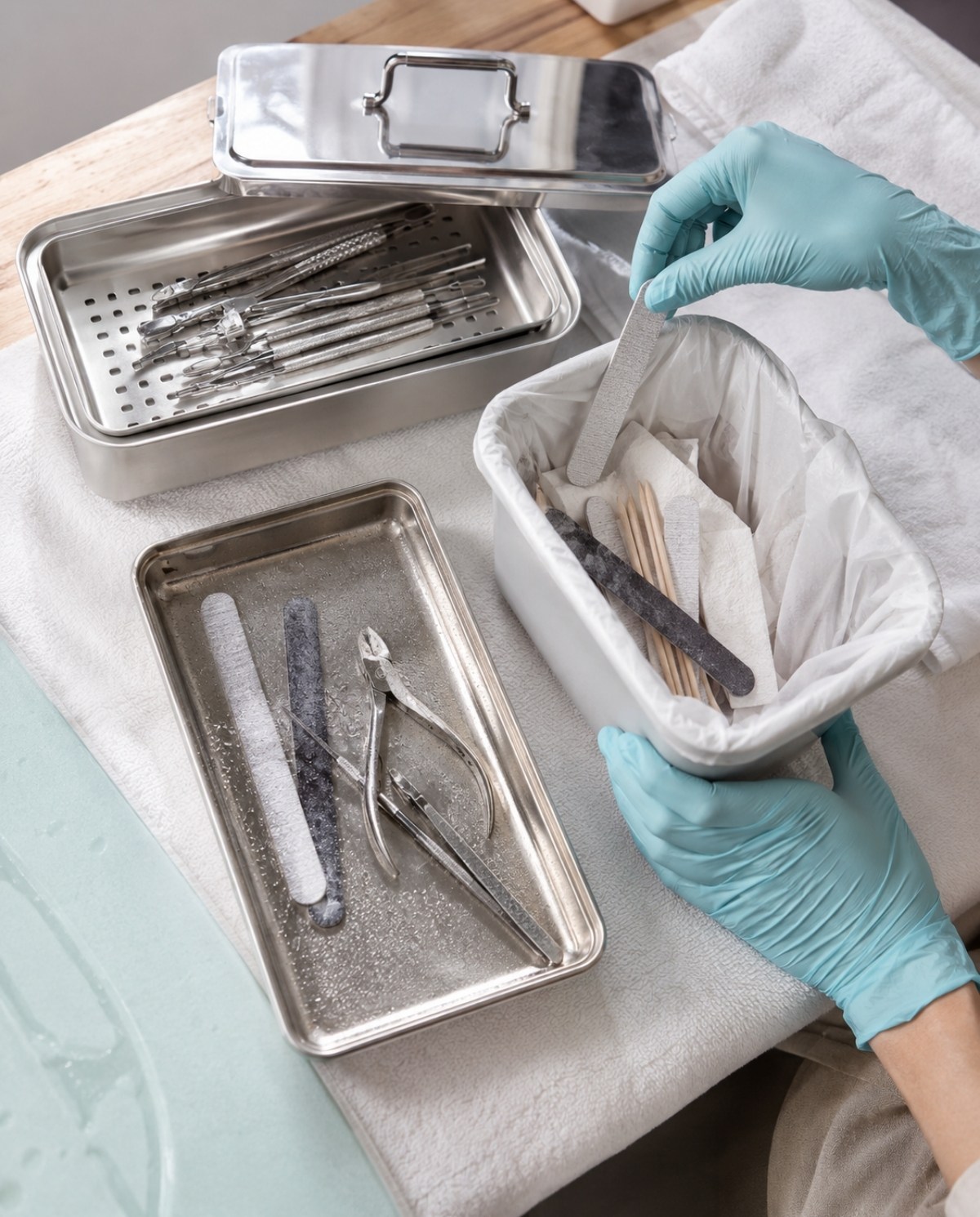
A Medical Nail Technician remains a beauty professional, but the way that person approaches an appointment may be more cautious than a conventional walk-in service. The process may include a detailed consultation, visual screening, sanitation documentation, conservative product choices, and a clear plan for referring concerns that do not belong in a salon setting.
The title is frequently used for licensed professionals who have pursued private education concerning older adults, people with diabetes, and clients whose health history may make routine services more complicated. The word medical describes the health-aware nature of the education. It does not mean the technician holds a healthcare license.
Common principles within this specialty include:
- Preventing Contamination: The CDC defines asepsis as preventing contact with microorganisms. In a nail setting, that may involve proper hand hygiene, preparing the workstation, using disposable supplies when appropriate, and cleaning and disinfecting reusable implements according to state rules and product labels. Asepsis is not identical to sterilization, which is intended to destroy all forms of microbial life.
- Considering Waterless Methods: Dry or waterless pedicures can reduce exposure associated with shared footbaths, but they do not eliminate every possible route of cross-contamination. Hands, surfaces, products, and reusable tools still require proper infection-control practices. Balance Health describes waterless care as a feature of many medical-pedicure services. The National Institute of Diabetes and Digestive and Kidney Diseases also advises people with diabetes not to soak their feet because soaking can make the skin too dry.
- Keeping Services Cosmetic: An MNT may provide nail and skin maintenance that falls within the professional's state-authorized scope. Painful, infected, bleeding, deeply ingrown, or significantly abnormal nails may need evaluation by a podiatrist or another qualified healthcare provider before any cosmetic service is considered.
- Knowing When Not to Proceed: Screening is not diagnosis. A technician may notice redness, drainage, swelling, warmth, open skin, or a sudden nail change and decide that an appointment should be modified, delayed, or declined. The technician can describe what is visible without naming the medical condition causing it.
- Selecting Products Conservatively: Product safety depends on the client and the condition of the skin. NIDDK specifically warns people with diabetes not to use liquid corn and callus removers because these products can damage the skin and cause infection. This guidance does not mean every exfoliating product is forbidden for every client, but it shows why stronger products require careful judgment.
The most important skill in this role is not treating a medical problem. It is recognizing when a cosmetic service may create unnecessary risk. An MNT does not remove infected tissue, provide wound care, prescribe an antifungal treatment, or attempt to correct a condition that belongs within podiatry or medicine.
Maintaining strong everyday sanitation remains essential whether you work with higher-risk clients or a general salon population. Our guide to nail salon hygiene and professional aftercare explains practical habits that help reduce cross-contamination and protect both clients and technicians.
Foot-care needs also extend far beyond the nail industry. Mordor Intelligence estimates the global podiatry services market at $4.87 billion in 2026 and reports that routine foot care represented 46.87% of that market in 2025. These are podiatry market-share figures, not MNT employment statistics. They show the significance of routine foot maintenance within the wider foot-health field but do not prove that every MNT will receive medical referrals or achieve a certain income.
Some healthcare practices may hire, work with, or refer suitable clients to safety-trained nail professionals. Such relationships depend on state law, office policies, professional experience, insurance arrangements, and the exact cosmetic services being offered. A certificate can support a professional introduction, but it cannot promise a job or referral stream.
Building the Credentials in the Right Order
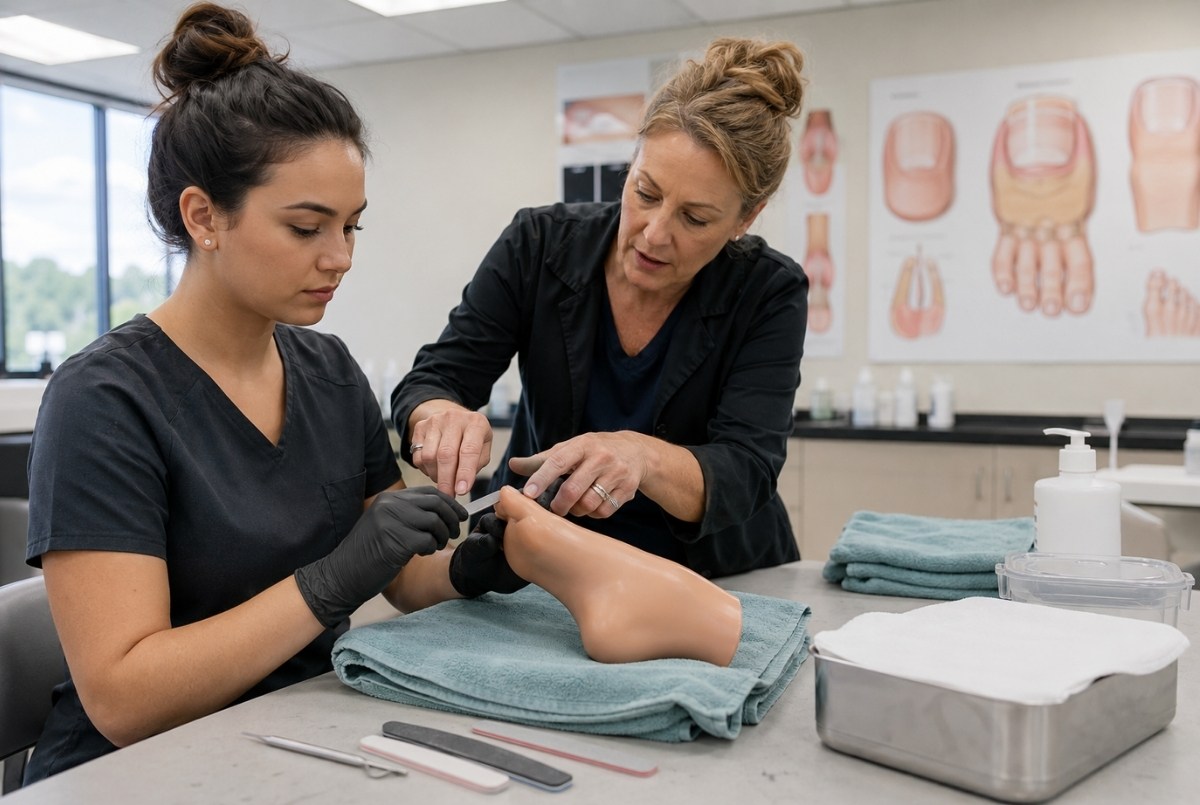
Before pursuing advanced education, you need the legal foundation required to work as a nail professional. That ordinarily means completing an approved nail or cosmetology program, satisfying the licensing agency's requirements, and obtaining the license required where you plan to provide services.
For a closer look at the difference between school completion and professional licensing, read our guide explaining whether a nail technician needs a certificate and how the licensure process works.
Arkansas publications currently contain figures that applicants should review carefully. The 2025 Arkansas cosmetology law compilation lists at least 480 hours of manicurist training as a prerequisite for examination eligibility. Meanwhile, Career Academy of Hair Design currently publishes its own Manicuring program as a 600-hour course that may be completed in approximately five months.
Because statutory language, administrative rules, school catalogs, and implementation dates are not always updated at the same time, applicants should confirm the operative licensing checklist directly with the Arkansas Department of Health before relying on a particular hour figure.
A foundational license alone does not make someone an MNT. The advanced title comes from a separate private provider, and the structure is not identical across the industry.
One established example is the pathway offered by Nailcare Academy. Within its system, the complete MNT sequence includes:
- Advanced Nail Technician, or ANT, certification
- Wellness Nail Technician, or WNT, certification
- The MNT internship preparation program
- A documented 40-hour proctored internship in a medical setting
Nailcare Academy states that its advanced programs in the United States are intended for licensed nail technicians and cosmetologists. Its MNT internship preparation program requires both ANT and WNT certification as prerequisites.
Another private provider may use a different title or sequence. Before enrolling, review the subjects covered, instructor experience, assessments, practical expectations, refund policies, internship arrangements, graduate support, and admission requirements. You should also compare the techniques taught with the services your state license actually permits.
Which Parts Can Be Studied Remotely?
Online education can make advanced theory more accessible to working professionals. Topics such as anatomy, infection prevention, chronic-condition awareness, consultation methods, documentation, and referral communication may be taught remotely.
Nailcare Academy states that its classes are online. However, its MNT certification process also includes a separate 40-hour proctored internship in a medical setting. The internship is guided by a procedure log that must be verified by the proctor before the MNT certificate is issued.
The internship should not be described as purely observational. According to the provider, it can introduce technicians to medical-office expectations while allowing them to perform or document cosmetic activities that remain within their existing state license and the supervising site's policies. It never gives the student permission to diagnose vascular disease, neuropathy, fungal infection, or any other medical condition.
When comparing online programs, ask:
- Which lessons are completed online?
- How is knowledge or practical competency assessed?
- Is an internship required?
- Who is permitted to supervise the internship?
- Does the provider help students locate an appropriate site?
- Must applicants already hold an active nail or cosmetology license?
- What happens if the student's state does not allow a technique taught in the course?
Your Certificate Never Replaces Your State Scope
Advanced knowledge can improve decision-making, but it does not rewrite licensing law. A private MNT certificate cannot add procedures to an Arkansas manicurist license or permit the holder to practice podiatry.
The Arkansas Cosmetology Act defines the work authorized under a manicurist license, including cosmetic services such as cutting, trimming, cleansing, filing, polishing, protecting, extending, or beautifying nails, along with specified cosmetic care of the hands, arms, feet, and ankles. The license does not authorize medical diagnosis or treatment.
An explanation from Nailcare Academy also states that ANT, WNT, and MNT certificates do not enlarge the technician's original state scope of practice. Working in a physician's office does not independently grant a technician the authority held by the physician.
Visible concerns that may justify delaying a cosmetic service and recommending medical evaluation include:
- Open cuts, sores, ulcers, or active bleeding
- Blisters, drainage, or signs suggesting infection
- Unusual redness, warmth, swelling, or inflammation
- Severe pain or a sudden change in a nail or foot
- An ingrown nail that has entered or broken the skin
- Thick, yellowed, curved, or significantly distorted nails in a person with diabetes or reduced sensation
- A client who cannot adequately see, feel, or reach their feet
NIDDK advises people with diabetes to have a foot doctor trim their toenails when they cannot see, feel, or reach their feet, when their nails are thick or yellowed, or when the nails curve and grow into the skin. That guidance supports referral to an appropriate medical professional rather than aggressive cosmetic intervention.
Certification also does not remove professional liability. Technicians must follow applicable licensing and sanitation rules, employer policies, product directions, and the boundaries of their training.
Professional liability insurance and detailed client forms may be required by an employer, landlord, referral partner, insurer, or certificate provider. They should not automatically be described as universal Arkansas licensing requirements unless a current law or rule specifically requires them. Even when not mandated, suitable insurance and consistent documentation may still be valuable business safeguards.
Income Potential Without the Hype
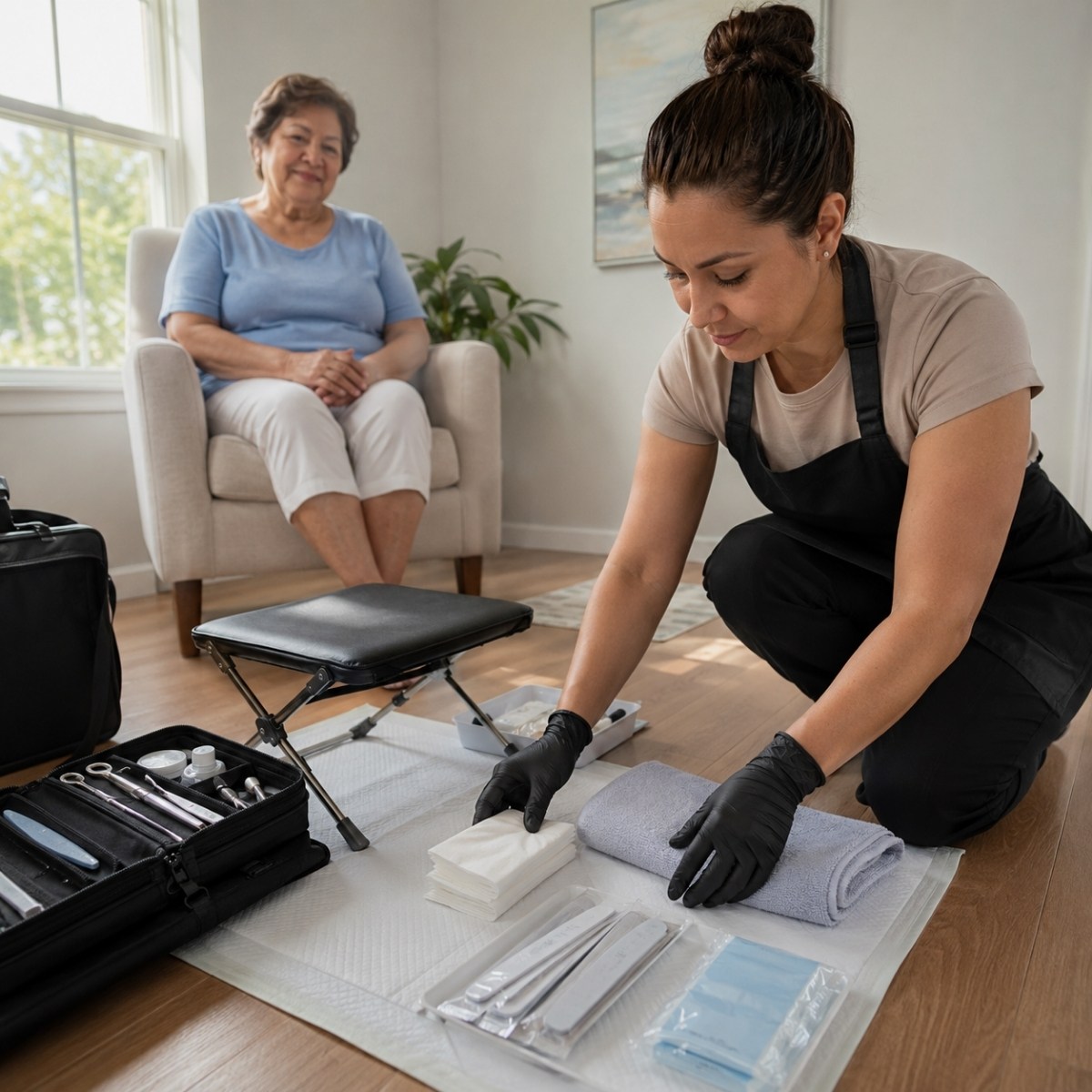
A focused specialty may help a technician distinguish their services through longer consultations, careful sanitation, structured screening, and a quieter appointment experience. It may also appeal to clients who value extra time and attention. However, none of those benefits creates a guaranteed premium price or stable income.
Medical Nail Technicians are not tracked as a separate occupation in federal employment databases. The latest national Occupational Employment and Wage Statistics release lists a median hourly wage of approximately $17.19 for manicurists and pedicurists in May 2025. The U.S. Bureau of Labor Statistics Occupational Outlook Handbook projects 7% employment growth for the broader occupation from 2024 through 2034, with about 24,800 openings per year on average.
These figures do not tell you what an independent MNT business will earn. BLS occupational wage estimates also exclude self-employed workers, which matters because many nail professionals operate independently.
Actual results may be influenced by:
- Local demand for specialized services
- State licensing restrictions
- Employment, booth-rental, suite, or business-owner status
- Appointment duration and pricing
- Client retention and referral activity
- Rent, supplies, equipment, insurance, taxes, and payment fees
- Unpaid scheduling, cleaning, bookkeeping, and marketing time
- The technician's experience and weekly booking capacity
A specialist may choose fewer appointments with additional consultation and documentation time. Whether that model supports higher prices depends on the market and the value clients perceive. It is not accurate to assume that clients will automatically pay substantially more simply because a technician earns an advanced certificate.
Gross service sales also should not be confused with personal income. Rent, products, continuing education, insurance, licensing, taxes, cancellations, and administrative work can significantly reduce the amount the owner keeps.
The realistic advantage of specialization is the ability to develop a clearly defined service model. The financial outcome still depends on pricing, demand, expenses, compliance, reputation, and business management.
Begin with a Strong Manicuring Foundation
Advanced safety education is most useful after you have developed dependable foundational skills. Nail anatomy, sanitation, product knowledge, consultation, client communication, and practical technique all contribute to the judgment required in a specialized setting.
At Career Academy of Hair Design, the current Manicuring program is listed as 600 hours completed in approximately five months. The program includes hands-on instruction in manicures, pedicures, nail enhancements, design techniques, client relations, salon business, client retention, resume writing, and job-seeking skills.
The program is available through the school's Arkansas campuses in Fayetteville, Fort Smith, Rogers, Siloam Springs, and Springdale. Students should confirm current schedules, availability, licensing requirements, and completion timelines directly with admissions.
Career Academy of Hair Design provides the foundational manicuring education. It does not represent the program as a Medical Nail Technician certificate. Graduates who become properly licensed and later want to pursue health-conscious nail specialization must research and complete suitable advanced education through a separate provider.
Visit the Enrollment page to request information about the Manicuring program, available campuses, class schedules, and the steps involved in beginning your nail-care education.
Questions Future MNTs Commonly Ask
Does an MNT certificate make someone a healthcare professional?
No. A Medical Nail Technician is generally a licensed beauty professional with additional private education. The credential does not make the holder a physician, podiatrist, nurse, or other licensed medical provider. It does not authorize diagnosing disease, prescribing medication, treating an infection, or providing wound care.
Can Medical Nail Technician services be billed to insurance?
Privately provided cosmetic nail services are generally paid for by the client and are not automatically converted into covered medical care because the technician holds an MNT certificate.
According to Medicare, routine foot care such as trimming nails and removing corns or calluses is usually not covered. Medicare Part B may cover medically necessary foot examinations or treatment for qualifying injuries or diseases when coverage conditions are satisfied and the services are delivered by an eligible healthcare provider. Clients should verify coverage with the medical practice and their insurance plan rather than assuming an MNT appointment is reimbursable.
How are ANT, WNT, and MNT credentials different?
The definitions depend on the private provider. In Nailcare Academy's pathway, the Advanced Nail Technician program focuses on advanced safety and professional salon practices. The Wellness Nail Technician credential follows as another prerequisite. The student then completes the MNT internship preparation program and a documented 40-hour proctored internship in a medical setting.
Therefore, within that system, completing ANT education and an internship alone is not the entire MNT pathway. The WNT credential is also required. Other providers may organize their certificates differently.
Can an MNT treat nail fungus or correct an ingrown toenail?
An MNT may recognize visible signs that justify referral, but the private certificate does not grant authority to diagnose fungus, treat infection, provide wound care, or perform a medical procedure.
A cosmetic service may sometimes be possible after a healthcare professional has evaluated the client, but that decision still depends on the client's condition, the technician's state scope, the medical provider's directions, and the services the technician is legally allowed to perform.
Is an MNT automatically qualified to work on every client with diabetes?
No. Diabetes does not affect every client in the same way, and an MNT certificate does not make every appointment safe. The technician must consider visible skin and nail conditions, the client's reported history, sensation concerns, existing medical instructions, and state scope-of-practice limits.
Clients with open sores, drainage, active bleeding, severe swelling, significant pain, or nails entering the skin may require evaluation from a healthcare professional instead of a cosmetic appointment.
Will the certificate let me practice in another state?
No. A private advanced certificate may remain part of your educational record, but it does not transfer or replace your underlying professional license. You must satisfy the licensing, reciprocity, endorsement, examination, and education requirements of the state where you intend to work.
The Cosmetology Licensure Compact is being developed to support interstate practice for eligible cosmetologists in participating states. The official website currently states that the compact is not yet issuing multistate licenses. Eligibility may also depend on the type of state license held, so a professional with a standalone manicurist license should not assume that the compact will apply.