


How to Get a Nail Technician Job With No Salon Experience

Starting a nail career can feel like running into a wall before you even begin. You look at salon job posts, notice that many employers prefer experience, and then wonder how you are supposed to gain that experience without getting hired first. If you have a new license, a small portfolio, and mostly school or practice work behind you, that nervous feeling is normal.
The good news is that a beginner does not need to pretend to have a long salon background. You need to show that you are safe, coachable, professional, and ready to grow. Salon owners often care just as much about reliability, sanitation habits, client communication, and basic technical control as they do about years on a resume. This guide walks through how to apply for a nail technician job with no salon experience, how to present your strengths, and how to walk into your first interview with more confidence.
Main Points to Know
- Demand is still growing: The U.S. Bureau of Labor Statistics projects 7% employment growth for manicurists and pedicurists from 2024 to 2034, with about 24,800 openings projected each year on average.
- Past service jobs still count: Retail, food service, hospitality, receptionist, or other customer-facing work can support your resume because salons need communication, time management, sales awareness, and client-care skills.
- Safety knowledge helps you stand out: Understanding labels, Safety Data Sheets, disinfection, ventilation, and ingredient concerns can make a new nail technician look more responsible and prepared.
- Licensing rules are local: Each state sets its own training, licensing, and salon-safety requirements. For example, Arkansas rules include a structured 600-hour manicure curriculum, so beginners should always check the rules for the state where they plan to work through sources such as the Arkansas cosmetology rules.
Turn a Beginner Resume Into Proof of Readiness
A resume with no salon job history should never feel empty. Instead of filling it with vague lines, use it to prove that you already have the foundation a salon owner wants to see. A strong CV for a nail technician without experience should focus on training, licensing progress, clinic practice, sanitation knowledge, and the professional habits you built before applying.
A modern nail technician CV with no experience should show technical promise, not just past employment. Include your completed program, license status, total training hours, clinic floor experience, sanitation training, and any extra workshops or practice areas you completed, such as e-file bit safety, gel application, acrylic fundamentals, or structured manicure work. To organize your skills more clearly, you can review our guide to core procedures and essential tools and compare your resume to the practical abilities salons often expect from new technicians.
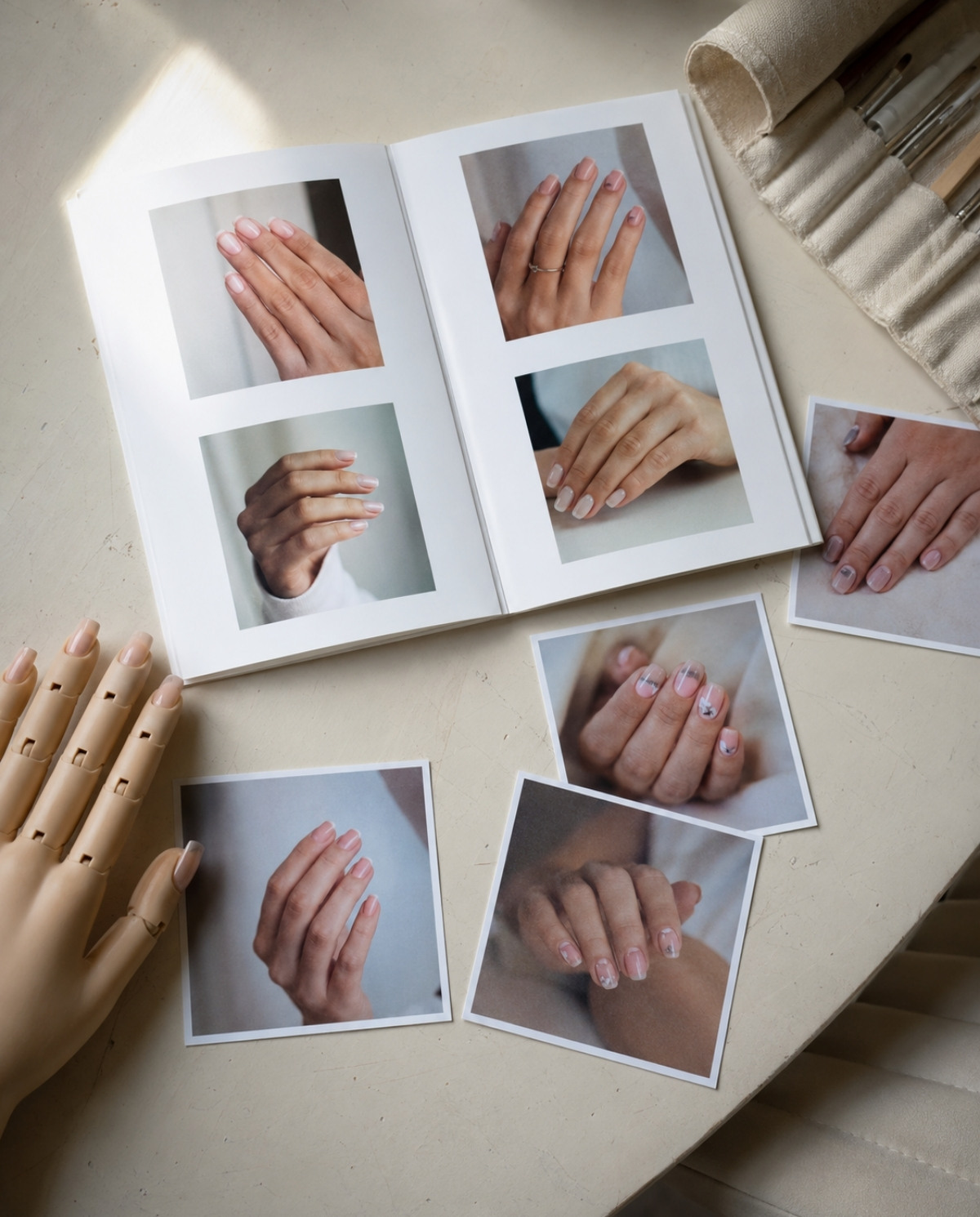
Your resume should also include a simple portfolio link. It does not need to be huge. A clean Instagram page, a Google Drive folder, or a basic digital portfolio with bright photos can show that you understand nail shape, prep, polish control, and clean presentation. For a beginner, a small nail technician portfolio that looks organized can be stronger than a long resume filled with unrelated details.
Use Transferable Work Experience the Right Way
If you have worked in retail, food service, hospitality, office support, or any customer-facing role, you already have experience that can matter in a salon. Salon owners want people who can speak to clients clearly, stay calm during busy hours, manage time, handle payments, suggest services or products, and keep clients comfortable.
For example, if you worked as a barista, do not reduce the job to "made coffee." A stronger line would be: "Managed high-volume customer orders under tight time constraints while maintaining strict health and safety protocols." If you worked in retail, highlight product recommendations, customer questions, checkout accuracy, and problem-solving. These details show that you understand the service side of beauty work, which can make you feel like a lower-risk beginner hire.
Your opening profile should also be specific. A strong objective for nail technician applicants should quickly show your safety mindset, interest in growth, and ability to work within a salon team. For example: "Licensed Nail Technician eager to bring strong sanitation habits, modern gel-system knowledge, and client-first hospitality to an entry-level role at a growing salon."
What the Job Outlook Means for Beginners
New technicians sometimes assume that every opening is already taken by experienced nail artists. However, the U.S. Bureau of Labor Statistics projects employment for manicurists and pedicurists to grow 7% from 2024 to 2034, which is faster than the average for all occupations.
The BLS also projects about 24,800 openings each year on average over that decade. Many openings are expected to come from workers transferring to other occupations or leaving the labor force, including retirement. This does not mean every salon will hire any new graduate immediately, but it does show that trained and licensed applicants still have room to enter the field when they present themselves professionally.
The BLS lists the median hourly wage for manicurists and pedicurists at $16.66 in May 2024. Real income can vary depending on the salon, location, tips, commission structure, booth rental costs, client volume, and whether the technician is an employee or self-employed. For a new technician, the first role is important not only for income, but also for building speed, repeat clients, confidence, and real salon credibility.
Write a Cover Letter That Feels Specific
Your resume explains your skills, but your cover letter explains why you are a good fit for that particular salon. When writing a personalized cover letter for nail technician openings, avoid sounding like you sent the same message to every business in town. Salon owners can usually tell when a cover letter is generic.
A strong cover letter for nail technician with no experience candidates should show genuine interest, teachability, and respect for the salon’s standards. Some owners are open to hiring beginners because they can train them according to the salon’s timing, service flow, product systems, client style, and quality expectations.
What to Include in the First Few Lines
Start by addressing the owner, hiring manager, or salon manager by name when you can. Then explain why that specific salon caught your attention. You might mention their clean work, natural nail focus, nail art style, luxury pedicure menu, strong reviews, or education-focused culture.
You should also show that you understand scope of practice. That means knowing what your license allows you to perform and where the legal boundaries are. For example, you can explain that you understand the difference between professional exfoliation and invasive skin removal, and that you only perform services on intact, healthy skin and nails within your training and state rules.
For Arkansas-based beginners, it is also smart to understand state-board expectations before interviewing. The Arkansas cosmetology rules include requirements connected to sanitation, personal cleanliness, disinfectant use, properly labeled containers, pedicure-spa cleaning, and safe storage of clean items. Mentioning that you take these rules seriously can help an entry-level applicant sound more prepared.
You can also strengthen your application by showing that you understand professional nail salon hygiene practices before you are hired. End the letter by saying you are willing to complete a practical test on a live model or practice hand so the salon can evaluate your current skill level.
Use Product Safety Knowledge as an Advantage
Modern salon owners have to think about client safety, worker safety, product claims, and compliance. According to the U.S. Food and Drug Administration, the Modernization of Cosmetics Regulation Act, known as MoCRA, expanded FDA authority over cosmetics and includes requirements such as serious adverse event reporting and safety substantiation for cosmetic products.
A beginner nail technician does not need to act like they personally carry every manufacturer-level MoCRA responsibility. The better point is that you understand the modern safety environment around professional cosmetic products. The FDA's cosmetic registration and product listing guidance states that a responsible person must list each marketed cosmetic product with FDA, including product ingredients, and provide updates annually. This makes it even more important for salons to buy from reputable suppliers, read product labels, keep Safety Data Sheets accessible, and take client reactions seriously.
You can also stand out by knowing current ingredient warnings. For example, the FDA has warned that several cosmetic products marketed as gel nail polish removers were found to contain methylene chloride, also known as dichloromethane or methyl bichloride. FDA states that methylene chloride is prohibited in cosmetics at any level. If you know how to check labels, avoid questionable imported removers, and ask for Safety Data Sheets, you show that you care about protecting clients, coworkers, and the business.
Create a Beginner Nail Portfolio That Looks Professional
In nail care, visual proof matters. A digital portfolio can show your current ability faster than a resume can. You do not need years of paying clients to build one. You need clear photos, clean work, and enough detail to show that you understand the service process.
You can begin with practice hands, classmates, friends, family members, and school clinic work. The goal is not to show the most complicated nail art possible. The goal is to show control, consistency, sanitation awareness, and neat technique.
Choose Photos That Prove Clean Technique
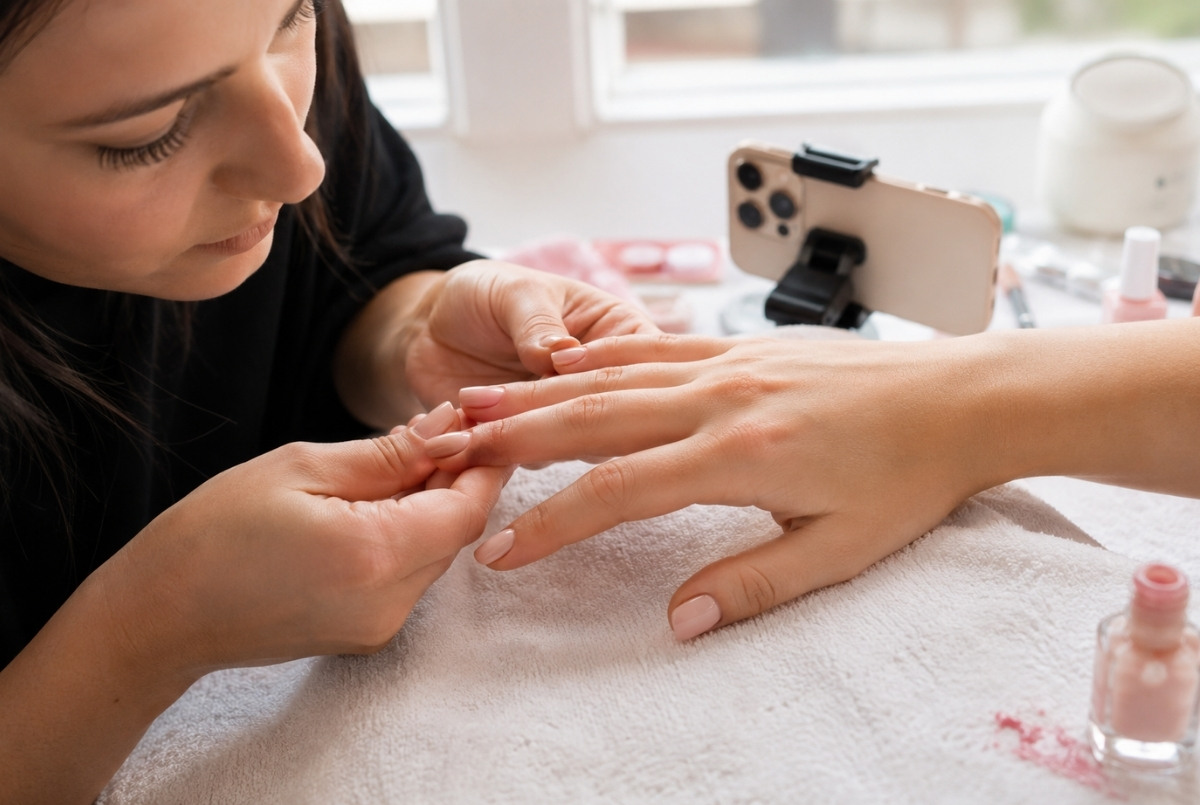
When photographing your work, avoid heavy filters, messy backgrounds, and distracting props. Use bright natural lighting or a clean ring light. Keep the background simple. Crop out clutter such as open containers, used files, dirty towels, or random product bottles.
Your portfolio should include several shapes, such as coffin, almond, and square. It should also show smooth polish application without flooding into the lateral nail folds. Include simple manicures along with nail art, because basic work often proves more than a complicated design with weak prep or uneven application.
For each image, add a short caption that shows professional thinking. Mention the service type, shape, product system, prep method, and whether the work was done on a practice hand or live model. A beginner portfolio feels stronger when it explains the process behind the finished set.
Add Product-System Awareness
A strong portfolio does more than show attractive colors. It also shows that you understand product systems and client safety. As discussed in a market trends analysis by Booksy Biz, modern salon conversations increasingly focus on cleaner positioning, ingredient awareness, and more specific product claims instead of vague "non-toxic" language.
Accuracy matters here. HEMA-free and TPO-free products are often marketed as ways to reduce exposure to specific ingredients of concern, but they do not make a service automatically risk-free. The FDA's nail care product guidance explains that many nail products contain potentially harmful ingredients but may be safe when used according to directions. The British Association of Dermatologists has also warned about allergic reactions connected to methacrylate chemicals used in acrylic nails, gel nails, and gel polish.
In your portfolio captions or interview conversation, explain that you follow the manufacturer's lamp, cure-time, product-thickness, and application instructions. Do not claim that any product is completely allergy-proof. Instead, show the habits that matter: avoid skin contact with uncured gel, cure correctly, do not casually mix incompatible lamps and gel systems, keep containers closed, and follow product instructions.
Prepare for the Salon Interview and Practical Audition
A salon interview can feel intimidating, especially when you are new. Preparation makes it easier. Before you walk in, practice common nail technician interview questions and answers so you can speak clearly instead of freezing.
Good answers should bring the conversation back to your strengths: your training, sanitation habits, client-service mindset, product awareness, and willingness to learn. If you already know how to answer tough interview questions for a nail technician with answers that sound calm and honest, you will feel more prepared in front of a salon owner or manager.

How to Answer the Experience Question
A salon may ask how you would handle a fast-paced environment if you have not worked in a commercial salon before.
Do not apologize for being new. A better response would be: "During my beauty school clinic floor hours, we worked under time limits to simulate a real salon environment. I learned how to manage my setup, perform a clear consultation, complete a clean service, and maintain sanitation protocols throughout the appointment. I know I still need to build speed, but I already understand how to stay organized, safe, and coachable under pressure."
If the salon asks for a practical audition, ask in advance what they want you to bring. If you bring your own tools, make sure reusable implements are cleaned, disinfected, dried, and stored in a clean covered container according to state-board rules. Keep clean tools away from used tools. Do not reuse porous single-use items such as certain files, buffers, orangewood sticks, or toe separators unless your state rules and product instructions clearly allow proper disinfection.
For Arkansas applicants, remember that sanitation rules are not just theory. The Arkansas cosmetology rules cover important expectations such as personal cleanliness, disinfectant use, labeled containers, clean storage, and pedicure equipment sanitation. During the audition, explain your steps as you work. Show how you protect the natural nail plate, avoid overfiling, reduce cross-contamination, and keep the station clean. Figuring out how to get a job as a nail technician is strongly connected to how safely you perform under pressure.
Set Up a Safer Workstation
One serious workplace concern for nail technicians is repeated exposure to dust, vapors, and chemical ingredients, especially in poorly ventilated salons. The Occupational Safety and Health Administration advises salon workers and employers to choose safer products, read product information, use appropriate gloves, avoid surgical masks for chemical protection, and rely on good ventilation and work practices to reduce exposure.
Ventilation can also be part of building-code requirements. The International Code Council explains that the International Mechanical Code requires source-capture systems at manicure and pedicure stations, with a minimum exhaust rate of 50 CFM at each station and exhaust inlets located close to the point of chemical application when factory-installed inlets are not provided. Requirements can vary by jurisdiction and salon build-out, so ventilation should be treated as both a worker-safety issue and a local-code issue.
During a salon walkthrough or practical test, respect the setup around you. Use closed product containers, keep waste controlled, pay attention to downdraft tables or source-capture systems, and avoid messy station habits. These details show that you are not just trying to get hired quickly. You are trying to become a professional who protects clients, coworkers, and your own long-term health.
Ready to Begin Your Nail Career?
A strong beauty career starts with training that gives you confidence in both technique and professionalism. If you are trying to move from practice work into real salon opportunities, the right school environment can help you build the habits employers want to see: clean service flow, sanitation discipline, client communication, and steady hands-on practice.
At Career Academy of Hair Design, students can explore beauty training options designed to help them build practical skills for the professional salon environment. To learn more about upcoming start dates, schedule a personal campus tour, or connect with the admissions team, visit the Enrollment page. You can also leave your details in the contact form below this article, and the team can help you understand your next step.
Frequently Asked Questions
Do I need a nail technology or cosmetology license before working in a salon?
Yes, in most situations, you need a valid state-issued license before performing manicures, pedicures, and nail enhancement services for compensation. The U.S. Bureau of Labor Statistics explains that manicurists and pedicurists must complete a state-approved cosmetology or nail technician program and pass a state exam for licensure.
Requirements are not identical in every state. Arkansas, for example, includes a 600-hour manicure curriculum in its cosmetology rules. That is why beginners should confirm current state-board requirements before assuming one pathway applies everywhere. A dedicated beauty school pathway remains one of the clearest ways to build training hours, sanitation knowledge, and state-board readiness.
How are entry-level nail technicians usually paid?
Entry-level pay structures often fall into three categories: hourly pay, commission, or booth rental. For a beginner with no existing client base, hourly pay plus tips is often the safest starting point because it gives you more stability while you build speed, confidence, and repeat clients.
Commission and booth rental can become better options later, but they usually require strong rebooking habits, regular clients, and a clear understanding of product costs and business expenses. According to the BLS, the median hourly wage for manicurists and pedicurists was $16.66 in May 2024, but real take-home income can vary based on location, tips, service pricing, schedule, salon model, and employment structure.
Can someone work as a nail technician while pregnant or dealing with breathing sensitivities?
Many people can work in nail care while pregnant or managing respiratory sensitivities, but they should take exposure seriously and speak with a healthcare professional about their specific situation. Better ventilation, closed product containers, appropriate nitrile gloves, source-capture dust control, and careful product choices are more reliable than depending on a basic mask alone.
The OSHA nail salon chemical hazard guidance warns that surgical masks do not protect workers from gases, vapors, or particulates. OSHA also explains that NIOSH-approved N95 respirators can help with particulates such as dust from buffing or filing, but they do not protect against chemical vapors or gases. If vapor protection is required, the employer must evaluate exposure and follow OSHA respiratory-protection requirements, including correct respirator selection, medical evaluation, fit testing, and training.