


Essential Client Intake Forms and Policies for Nail Technicians

Main Points to Remember
- Client Screening & Recordkeeping: Consultation forms allow nail technicians to identify possible allergies, health factors that may affect a service, and existing natural-nail damage before starting, while maintaining a consistent record of the consultation.
- Professional Boundaries Protect Your Schedule: Clear rules for cancellations, deposits, late arrivals, payments, repairs, and client communication can prevent confusion and establish expectations before problems arise.
- Working Within Your License: Nail professionals must remain inside the cosmetic scope allowed by their license and recognize situations where unhealthy or damaged skin and nails may require a service to be changed, postponed, or refused.
- Reducing Product-Related Risks: Thorough consultation, responsible product use, proper curing, and keeping uncured nail products away from the skin can help reduce the likelihood of Acrylate Allergic Contact Dermatitis. Nail technicians should also understand the rules their state applies to products such as Methyl Methacrylate (MMA).
Starting your first job behind a nail table can be exciting, but it also introduces situations that technical practice alone may not prepare you for. New technicians often spend most of their training time improving application skills and nail art while giving less attention to client screening, written policies, and service documentation. Those systems are an important part of professional practice because they help you manage appointments consistently, make safer service decisions, and communicate your expectations before misunderstandings develop.
Why Strong Salon Policies Matter From Day One

Clients should understand your rules before their appointment begins. A written policy covering cancellation deadlines, deposits, late-arrival limits, accepted payments, repairs, and communication standards makes those expectations easier to understand while helping you protect the time reserved for each service.
Written guidelines can also simplify conversations with new clients. Someone booking for the first time may have questions about pricing, appointment length, nail-art requests, deposits, repairs, or whether they need to send reference photos beforehand. Having these details available in advance reduces unnecessary back-and-forth communication and makes the booking process more predictable.
Consistency is especially important when enforcing your rules. Applying the same standards to late arrivals, missed appointments, service changes, refund requests, and repairs prevents you from having to invent a new response each time a problem occurs. Developing these professional habits works alongside core nail technology procedures and essential tools, where technical skills, safety practices, and proper equipment preparation all contribute to stronger professional performance.
According to a Research and Markets industry report, the worldwide nail salon market is projected at $14.08 billion in 2026 compared with $12.98 billion in 2025. The report also identifies greater attention to hygiene and safety standards as an emerging industry trend. A separate Grand View Research analysis points to increasing consumer interest in ingredient safety, sustainability, and clean-beauty nail products. These trends do not mean nail salons need to operate like medical facilities, but they do show why visible safety practices, proper consultation, and transparent policies can contribute to client confidence.
What Your Client Intake Form Should Cover
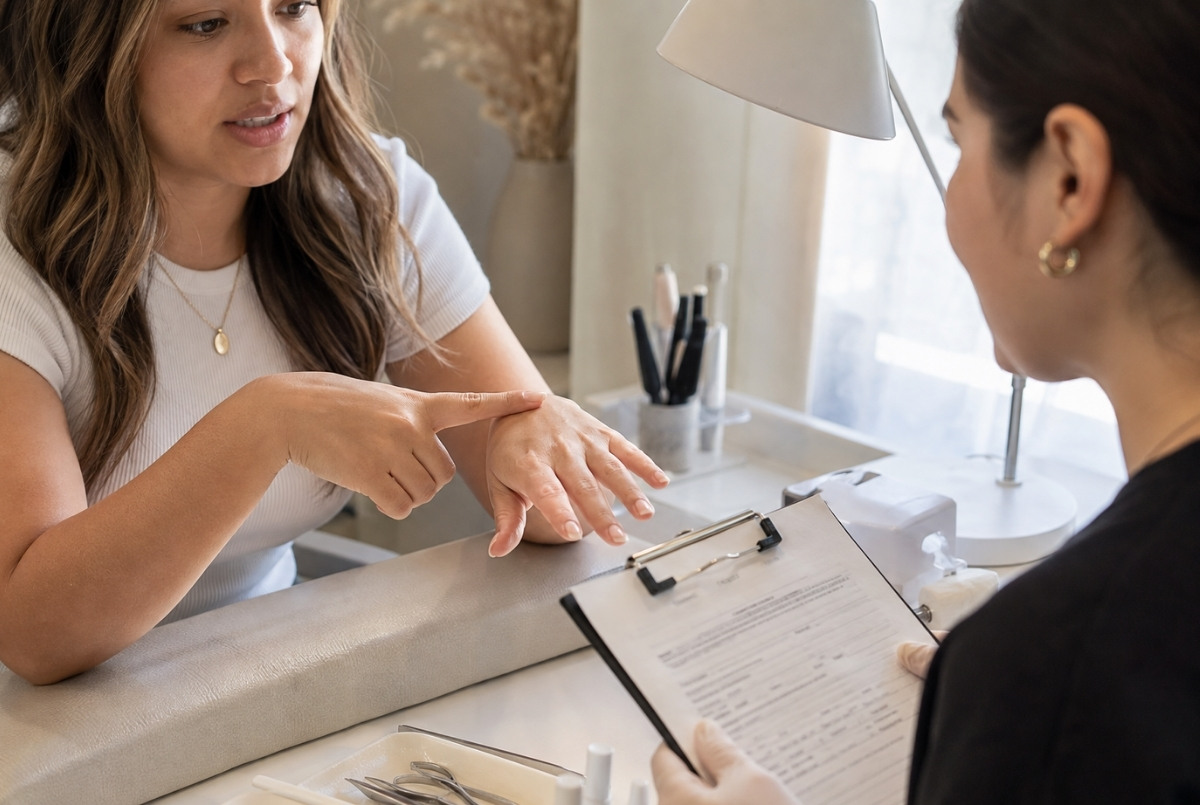
A client intake form gives you a structured way to collect information that may influence how a nail service should be performed. Written forms are not legally required in every jurisdiction, but they can make the consultation process more consistent. For a new client, the form provides an initial record that can later be updated when allergies, medications, health history, nail conditions, or previous product reactions change.
- Previous Product Reactions: Ask whether the client has experienced a reaction to gel systems, acrylic products, nail adhesives, primers, solvents, or similar products. Acrylate and methacrylate monomers are found in many nail systems, and repeated exposure, uncured material contacting the skin, or inadequate curing can contribute to sensitization and Acrylate Allergic Contact Dermatitis.
- Health Factors That May Affect the Service: Diabetes, peripheral neuropathy, and circulation problems can influence service decisions, particularly during pedicures. The Centers for Disease Control and Prevention explains that diabetes can cause nerve damage and reduced blood circulation in the feet, which may allow injuries to go unnoticed and make certain wounds slower to heal. Nail technicians should not diagnose these conditions, but disclosed medical history can support a more cautious service approach or a referral when concerning signs are visible.
- Previous Damage or Trauma: Ask about recent enhancement removal, injuries, painful nail appointments, or aggressive filing. A client who has pulled off acrylic enhancements or had the natural nail over-filed may have a thin, sensitive, or visibly damaged nail plate. Learning this before starting helps you determine whether the requested service is suitable, needs adjustment, or should be postponed.
- Service Documentation: Your client record may also include the products or system used, visible changes in the skin or nails, reactions that occurred during the appointment, service modifications, and whether you suggested seeking professional medical evaluation. Record observable facts rather than assigning medical diagnoses.
Research published in PubMed / Nursing for Women's Health describes Acrylate Allergic Contact Dermatitis as an increasing concern for both manicure consumers and professionals. Repeated acrylate exposure and improper curing are important contributors to sensitization. Possible reactions include itching, redness, swelling, dermatitis around the nails, and nail changes such as onycholysis. Once a person becomes sensitized, later contact with the same or chemically related acrylates may lead to further reactions, making a confirmed allergy important information for future services.
Acrylate sensitivity may also matter outside a nail salon. A review of acrylate exposure explains that acrylates and methacrylates are used in dentistry as well as different medical products. Medical literature has also documented acrylate allergens in certain glucose-monitoring devices and adhesives. Having an acrylate allergy does not automatically prevent someone from receiving dental care, surgery, or using a medical device. However, someone with a confirmed allergy should inform their dermatologist, dentist, surgeon, or other healthcare provider so the specific allergen and possible material alternatives can be considered.
Marketing claims on nail products should also be interpreted carefully. A product labeled "HEMA-free" is not necessarily free of every potential allergen because HEMA is only one methacrylate sensitizer. A laboratory study published in Contact Dermatitis and indexed by PubMed tested 31 gel nail products and six acrylic products. Methacrylates were detected in 32 of the 37 products, and each of those 32 had a difference between the methacrylates detected through testing and those disclosed on the packaging. HEMA itself was found in 20 of the 37 samples. For technicians, the practical takeaway is to avoid assuming that a marketing claim makes skin exposure harmless. Keep uncured products away from the skin, use compatible products as intended within their systems, and follow manufacturer instructions for application and curing.
When to Pause, Adjust, or Decline a Nail Service
A nail license allows cosmetic services within a defined legal scope; it does not authorize a technician to diagnose or treat medical conditions. Rules differ between states, so technicians need to understand both the services their license permits and the circumstances in which local regulations require them to stop or alter a service. Georgia, for example, defines nail-technician services to include manicures, pedicures, shaping, trimming, filing, decorating, artificial nail extensions, and care of another person's nails. Its State Board facility rules also require cosmetology services to be performed on intact, healthy skin and nails.
The technician's responsibility is to identify visible concerns without turning those observations into medical diagnoses. Depending on state rules and what is visible during consultation, postponing, changing, or refusing the requested service may be appropriate when signs include:
- Unusual nail discoloration, lifting, thickening, crumbling, or distortion that may be associated with trauma, infection, or another condition outside routine cosmetic nail care
- Skin surrounding the nail that appears severely red, swollen, hot, painful, or is producing drainage
- Bleeding, open wounds, broken skin, significant irritation, or a spreading rash within the area being serviced
- Green discoloration underneath a separated natural nail or lifted enhancement, which can occur with bacterial colonization and should not be diagnosed or concealed beneath another nail product by a technician
Your documentation should describe the condition you actually observe. Writing "green discoloration beneath lifted product" or "swollen red skin with drainage" keeps the record factual. Writing medical labels such as "Pseudomonas," "fungus," or "paronychia" would go beyond your role unless a qualified medical professional has already provided that diagnosis. When the problem appears outside cosmetic nail care, the technician can defer the service and recommend evaluation by a dermatologist, podiatrist, physician, or another appropriate healthcare professional.
Requirements vary by jurisdiction, but regulations commonly restrict services involving compromised skin or nails. Georgia limits cosmetology services to intact and healthy skin and nails. Arkansas regulations similarly restrict practitioners from knowingly providing services to certain clients with infectious or communicable conditions and prohibit massage on skin that is open, inflamed, irritated, infected, or affected by an eruption. The requirements can be reviewed through the Georgia State Board rules and the official Arkansas cosmetology regulations.
Technicians interested in serving clients who require more careful risk screening may also explore medical nail technician training requirements and career opportunities. Advanced private education may provide additional instruction related to infection prevention, screening, and referral practices, but it does not change the legal scope established by a state-issued nail license. A private credential does not authorize medical diagnosis, wound care, or medical treatment.
Declining a service does not require telling the client what condition you believe they have. Explain the visible concern, tell them why proceeding with a cosmetic service may not be appropriate, and recommend professional medical evaluation when necessary. This allows you to protect the client's safety while remaining within your professional boundaries.
Salon infection-control guidance also demonstrates why technicians should follow their own state's specific requirements. The Connecticut Department of Public Health, for example, prohibits skin-cutting tools such as razor-style callus shavers and Credo blades and does not consider UV light boxes acceptable disinfection devices. UV cabinets may instead be used for dry storage of implements that have already been properly disinfected. Georgia also prohibits razor-type callus shavers, including Credo blades.
Disinfection requirements should likewise come from state regulations and the label of the disinfectant being used rather than from a single universal time recommendation. The U.S. Environmental Protection Agency explains that contact time refers to how long a treated surface must remain visibly wet for a disinfectant to work as directed. Different products and target organisms may require different contact times. When a product label requires 10 minutes, for example, the treated surface needs to stay visibly wet throughout those 10 minutes.
Managing Client Changes and Reporting Professional Concerns
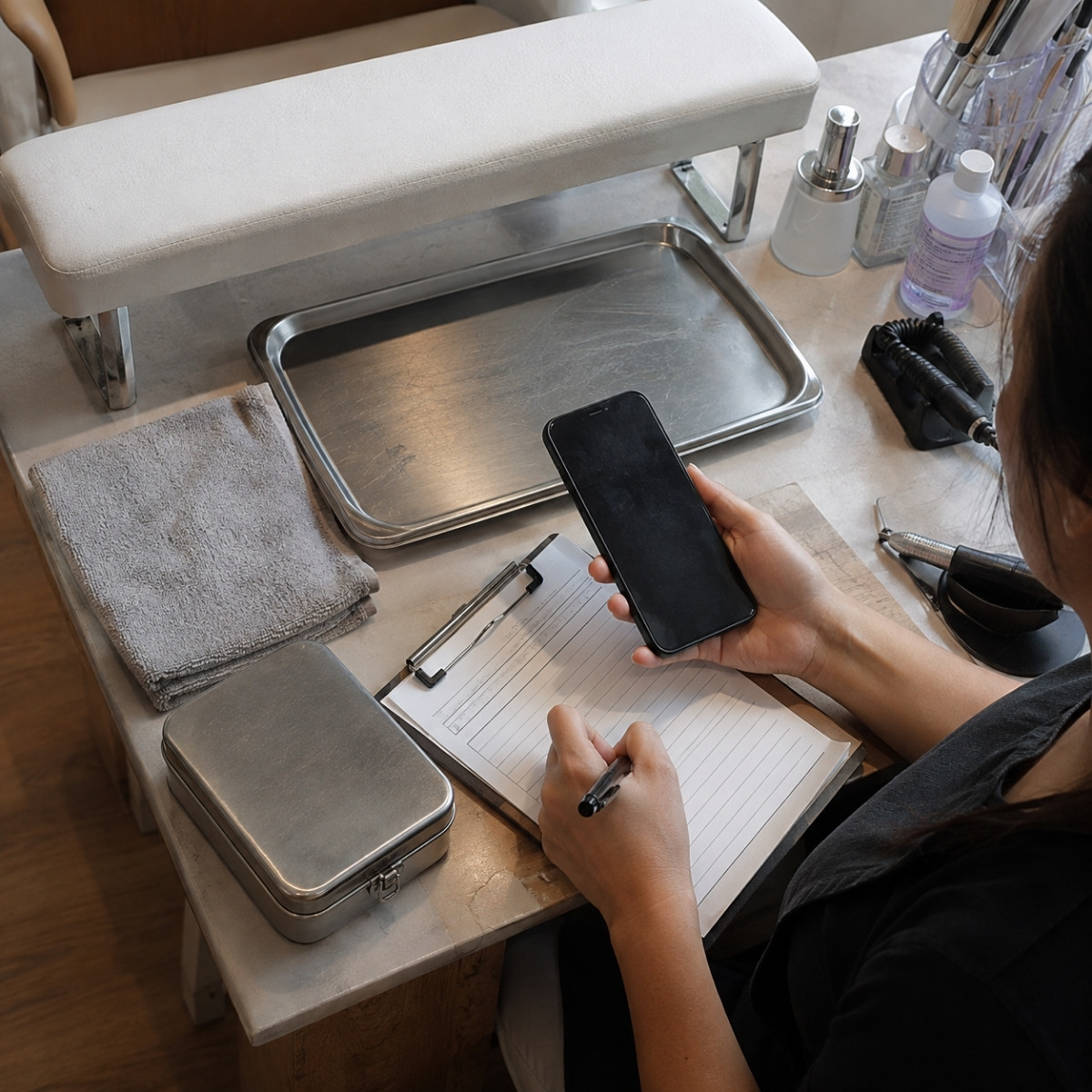
As you gain experience, not every situation you encounter will involve performing a nail service. You may also deal with clients ending a professional relationship, disputes about salon practices, or situations where you believe another practitioner may be violating licensing or safety requirements.
Clients sometimes move to another salon because of sanitation concerns, unexpected charges, communication problems, or dissatisfaction with their service. Understanding how to end a relationship with a nail technician respectfully can make that transition easier for the client, while maintaining clear policies in your own business can reduce confusion if one of your clients decides to leave. Providing common nail technician questions and answers on your website can also help prospective clients understand your expectations before making their first appointment.
Building trust also involves explaining what happens before, during, and after a nail appointment. Teaching clients about proper nail salon hygiene and professional aftercare can demonstrate how you reduce cross-contamination at your station while giving clients practical information for maintaining their nails between services.
Technicians should also know where to report suspected unlicensed practice or possible violations of professional safety and licensing rules. These reports should concern matters that fall within the jurisdiction of the relevant state cosmetology authority. In Georgia, the State Board of Cosmetology and Barbers complaint process accepts written complaints involving possible licensing violations and unlicensed activity. The Board also explains that ordinary disputes involving fees or private contracts generally do not fall within its authority, meaning that a disagreement about price or a refund does not automatically become a licensing violation.
Methyl Methacrylate, commonly abbreviated as MMA, is another regulatory topic nail professionals should understand. MMA should not be described as universally prohibited under federal cosmetic law. The U.S. Food and Drug Administration states that there is no federal regulation specifically banning methyl methacrylate monomer from cosmetic products. However, after receiving injury complaints connected with artificial-nail products containing 100% MMA monomer during the early 1970s, FDA took enforcement actions that included court cases, seizures, and recalls. States may impose their own additional restrictions or prohibitions on its use in professional nail services.
Information from the Arizona Barbering and Cosmetology Board further explains concerns surrounding MMA in the nail industry. The Board notes that MMA products may cost considerably less than Ethyl Methacrylate, or EMA, and can create enhancements that become extremely hard and difficult to file or remove. Instead of trying to determine what product another salon uses based solely on its prices or appearance, technicians should understand the regulations in their own state, purchase professional products from identifiable suppliers, retain relevant product information, and direct suspected regulatory violations to the appropriate authority.
Common Questions About Consultation and Salon Policies
How long should client consultation records be stored? There is no single nationwide rule establishing how long every nail technician must retain client intake forms. Review any applicable state requirements, the terms of your professional liability insurance, and your own business record-retention procedures. Health-related and consultation records should be stored securely for whatever period your policy or applicable requirements specify.
Can separate intake questions be used for services such as pedicures or hard gel? Yes. A general client form can cover basic medical history, allergies, and previous product reactions, while additional service-specific sections can address information relevant to extensions, gel systems, pedicures, or other procedures. Recording the products used during each appointment and updating the client's information when circumstances change can also make the record more useful.
What happens if a client will not complete the consultation form? Explain that consultation is part of your salon's process for evaluating whether a requested service can be performed appropriately. If your own policy, insurance requirements, or applicable state rules require completed documentation, do not perform the service without it. Even where no particular written form is legally mandated, a technician should postpone or decline the appointment when there is not enough information to determine whether the service can be safely performed within the technician's scope.
Build a Stronger Foundation for Your Nail Career
Technical ability is only one part of becoming a successful nail professional. Understanding your legal boundaries, communicating clearly with clients, maintaining consistent safety practices, and developing strong business habits can help you approach salon work with greater professionalism. Whether your long-term goal is to work in a spa, build an independent studio, or specialize further within the nail industry, combining practical training with sound professional judgment creates a stronger foundation for career growth.
To learn more about preparing for a future in the nail industry, visit our Enrollment page or complete the contact form at the end of this article to connect with our team.