


I remember when I first started exploring the beauty industry; I honestly thought being a nail technician was all about artistic flair and steady hands. It didn’t take long for me to realize that the real pros are actually masters of science and structural engineering. In 2026, the shift toward medical-grade services means we have to be more careful than ever about chemical safety and structural integrity.
If you are currently trying to figure out where you fit in this evolving landscape, I suggest taking a look at this 2026 guide to your new career to see how the industry is changing. According to recent data from Business Research Insights, nearly a third of clients now report sensitivities to traditional salon chemicals, so establishing yourself as a health-conscious specialist is a very smart move.
Key Industry Shifts For 2026
- Market Evolution: The nail sector is projected to hit $122.7 billion by 2035, largely driven by a demand for skin-first and medical-grade services.
- Regulatory Compliance: Under the latest MoCRA updates, you must understand product chemistry to navigate new FDA safety standards and recall powers.
- Structural Mastery: Success today centers on builder-in-a-bottle (BIAB) systems and precision e-filing rather than heavy, traditional acrylics.
- Clinical Care: Bioactive ingredients like calcium silicate are clinically proven to increase nail thickness by 39%, moving our role from artist to health consultant.
The 2026 Starter Kit Checklist
I know that the startup cost and the time commitment for a new career can feel a bit overwhelming. To help you plan, I recommend reading about the licensing path and professional requirements so you have a clear financial roadmap. When you are ready to assemble your nail technology kit, I find it easiest to organize your purchases into four main pillars.
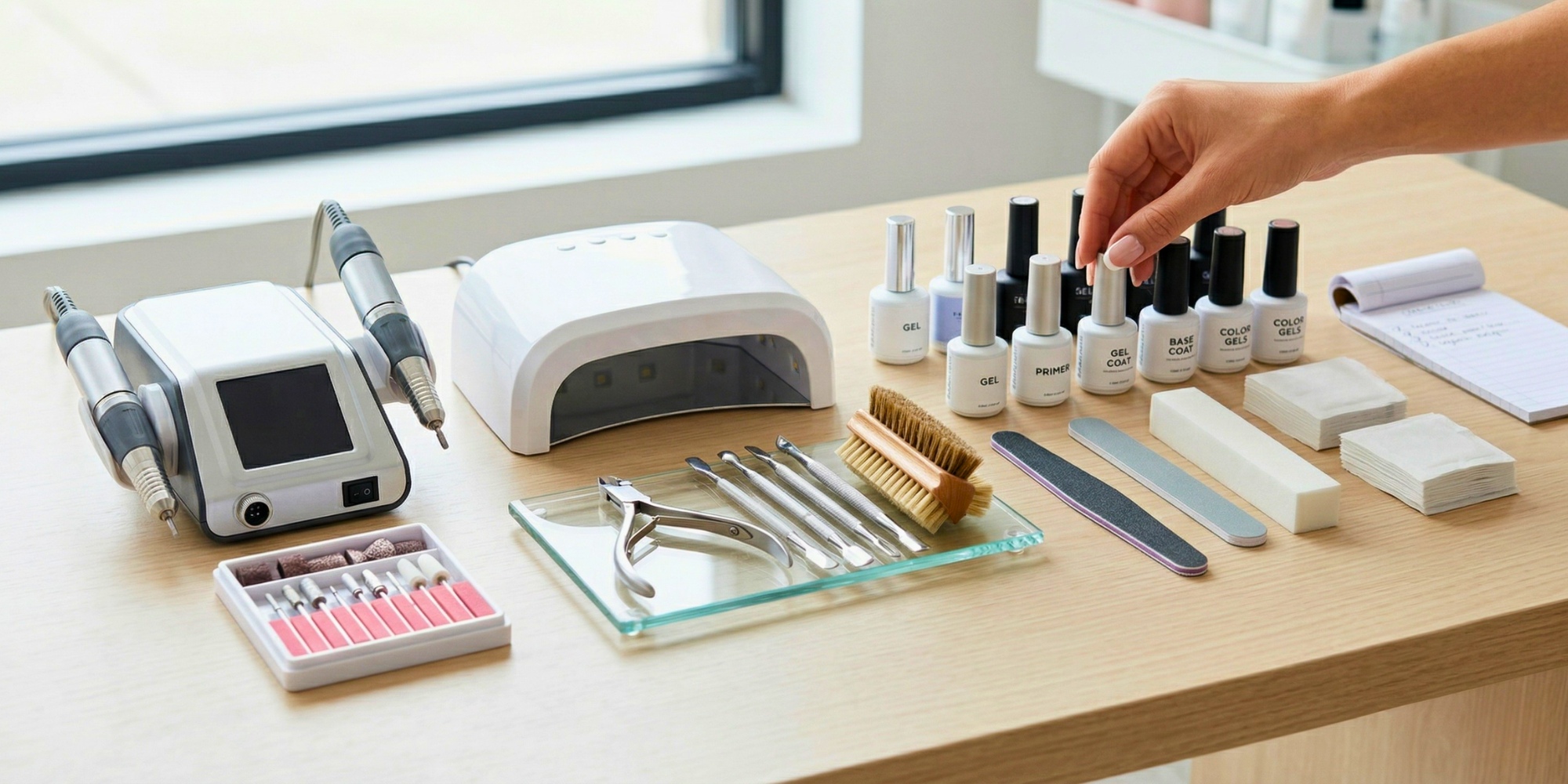
First, you have Equipment, which includes permanent assets like UV/LED lamps and high-torque electric files. Then you have Implements, which are multi-use steel tools like nippers and pushers. Next are Materials, which are the consumables like files, buffers, and wipes. Finally, there are the Professional Products, which cover the chemistry side – dehydrators, primers, and gels.
When people ask me what do beginner nail techs need, I always emphasize that their own health should be the priority. Your list of things for nail techs should definitely include a high-quality dust extraction system with a HEPA filter. In 2026, I consider this a critical requirement for a long and healthy career.
Defining The Tools Nail Technicians Use
A common mistake I see beginners make is spending too much money on trendy polish colors while neglecting the workhorse tools that actually generate revenue. It is important to distinguish between your daily operating costs and your long-term capital investments.
What Are Permanent Items Known As?
In a professional curriculum, you will often encounter the question: what are permanent items utilized in nail technology known as? These are officially categorized as Equipment and Multi-use Implements. Unlike disposables, these items represent your long-term infrastructure. High-quality stainless steel nippers and 48W+ UV/LED lamps are the backbone of your station. I always suggest investing in autoclave-ready steel to meet the clinical sanitation standards of 2026.
Specialized Hygiene And Modern Standards
Sanitation has moved way beyond a quick soak in blue liquid. High-performance nail technology tools, such as the Salmon Hygiene Technology nail brush, are now staples because their bristles are designed to resist bacterial load. Using these kinds of specialized tools nail technicians use is the fastest way to show a client they are in safe, professional hands.
The Impact Of MoCRA 2026
According to the FDA’s MoCRA updates, brand knowledge is now a legal safety requirement. In 2026, the FDA has mandatory recall authority, meaning your education regarding the products used in nail technology is a legal necessity for professional practice.
The Architecture Of Professional Extensions
To be a high-end technician today, you have to create extensions that look virtually indistinguishable from natural nails while remaining structurally sound. This requires mastering the C-curve and the Apex, which are the pillars of professional nail technology procedures.
The C-curve is the horizontal arch of the nail when viewed from the tip, providing the structural vault needed to prevent the nail from being too flat. The Apex is the highest point of the nail from a side view. It serves as the reinforcement zone; by placing the bulk of your product here, you ensure the nail can absorb daily impacts without cracking.
Mastering Nail Forms
Learning how to put a nail form on correctly is an essential skill for any student. Unlike plastic tips, a form allows you to sculpt a custom extension based on the specific geometry of the client’s finger. Knowing how to put nail form templates flush against the skin prevents the structural failure that leads to painful breaks. If you have ever wondered how do you put on a nail form for the best results, it all comes down to that perfect fit against the hyponychium.
Once the form is set, the material you choose is critical. Many professionals now favor specialized products like diva nail technology builder gel. These structured manicures are driving higher service prices because they protect the nail’s natural lipid barrier while providing incredible durability.
Precision Technology And Bioactive Science
The electric file is often the most misunderstood part of any nail care nail equipment list. When I teach someone how to use an e-nail, I explain that we aren’t drilling into the nail; we are actually performing a very fine micro-exfoliation. Using diamond bits at low speeds allows you to clean the lateral folds with surgical precision, which makes your gel application last much longer.
Strengthening The Natural Nail Bed
We are currently in a skin-first era of nail care. I am a big fan of systems like OPI Nail Envy with Tri-Flex technology because they mimic the natural keratin structure of the nail. By understanding how the Triflex technology creates a flexible shield and how a nail care pen with nail matrix technology supports the growth center under the cuticle, you can offer truly restorative services.
Whether you are using OPI Nail Envy original strengthener with Triflex technology or OPI Nail Envy Tri-Flex technology, you are helping clients rebuild their nail health from the root up. These treatments, including the OPI nail strengthening treatment with Tri-Flex technology, are vital for helping clients recover from damage caused by improper techniques.
The Evolution Of Press-On Nails
If you think press-ons are just for home use, you would be surprised. In 2026, professional press-on nail technology has turned these into high-end, custom-painted sets. Understanding what are nail press-ons in a professional context allows you to generate income even when you aren’t physically at your desk.
A 2025 clinical evaluation published by MDPI proved that bioactive formulations can increase nail thickness by 39% in just 28 days. When you can explain the reason behind the nail technology products you use, you transition from a service provider to a nail health consultant.
Aftercare Advice And Career Growth
My work doesn’t stop when the top coat is dry. The most successful technicians provide detailed aftercare advice for nail technology that focuses on managing mechanical stress. If I can teach my clients not to use their nails as tools, my work stays pristine, leading to the five-star reviews that grow my career.
The market is moving fast, and there is a massive opportunity for specialists who understand these advanced nail tools and uses. By choosing a path that emphasizes quality and safety, you are positioning yourself for success from day one.
Start Your Professional Journey
The move toward health-focused and medical-grade services is a huge opportunity for anyone starting out right now. At NWA Beauty Academy, I see every day how a salon-ready approach helps students prepare for the real world. We make sure you get hands-on experience with the same professional tools and products used in nail technology that top-tier salons expect you to know.
If you are ready to see what your future could look like, I invite you to find out more in Enrollment. You can also reach out through the contact form we’ve left at the end of this article to ask questions or schedule a time to visit us. I look forward to helping you build something beautiful.
FAQ: Mastering Your Nail Technology Tools
What do nail techs use for professional work versus home care?
Professional gear is much more powerful and precise. In school, you learn to use high-torque e-files and LED lamps with specific wavelengths that ensure the gel is fully cured, which is essential for preventing the allergies often caused by weak, consumer-grade equipment.
How do I choose the best tools used in nail technology for my kit?
I always suggest sticking to a consistent system. Using the base, color, and top coat from the same brand ensures the chemical bonds are compatible, which stops the nails from peeling or lifting too early.
What tools do you need to be a nail technician in a medical-grade salon?
You will need specialized nail technology tools including an autoclave for sterilization, professional-grade e-file bits, and a kit that focuses on hypoallergenic products to keep your clients safe from irritation.